
How to Self-Publish a Children's Book: A Complete, Honest 2025 Guide That Works
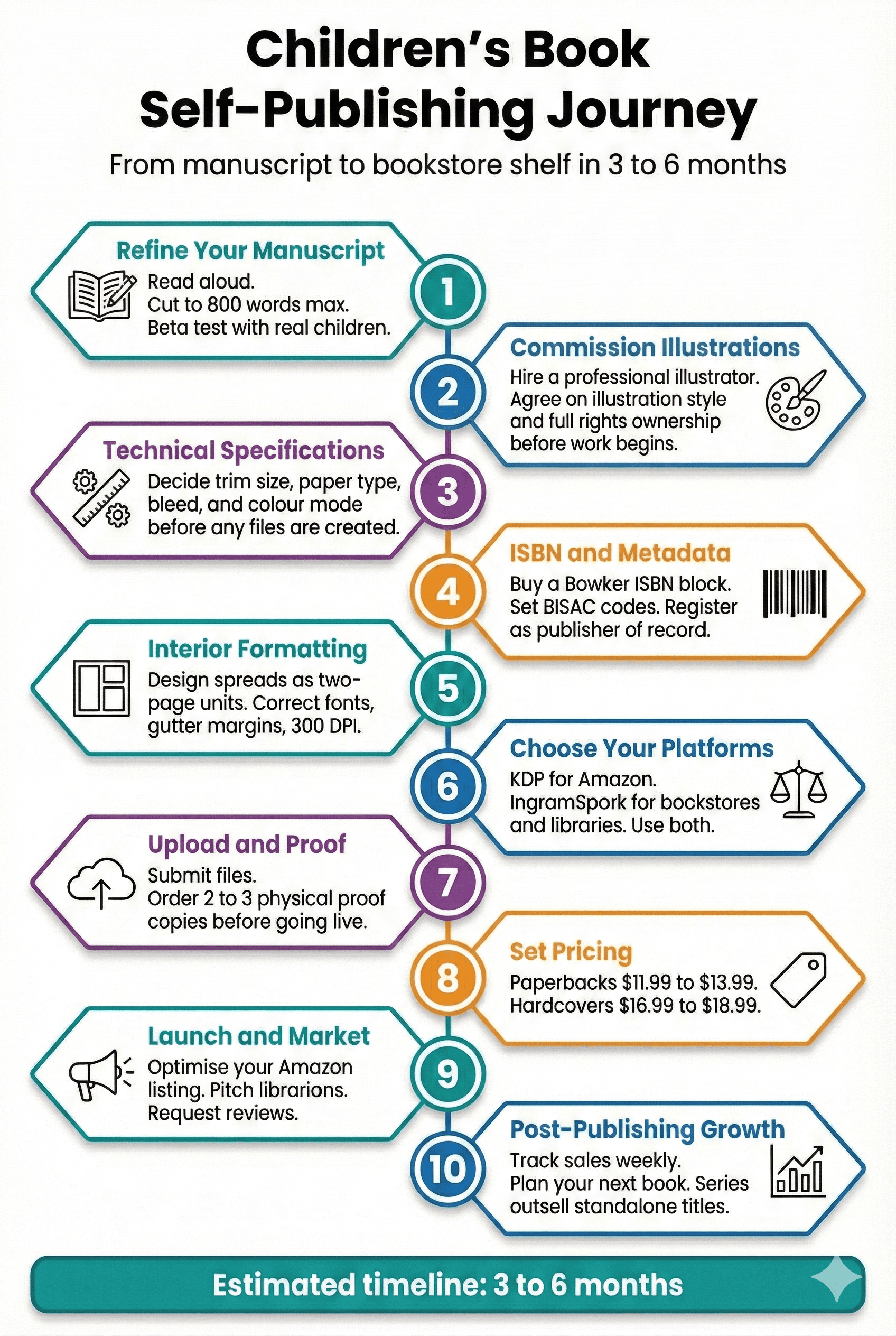
The 10 Steps to Self-Publishing
a Children's Book
- Finalize your manuscript and run a proper read-aloud test
- Hire a professional illustrator (this single decision drives 80% of your sales)
- Choose trim size, paper type, and technical specifications before any file is created
- Register your own ISBN through Bowker so you are listed as publisher
- Format interior and cover files to platform specifications
- Upload to Amazon KDP for Amazon sales
- Upload to IngramSpark for bookstore and library distribution
- Price between $11.99 and $13.99 for paperback picture books
- Order physical proof copies from both platforms before going live
- Build reviews, email list, and school visit opportunities from launch day
You have a story. Maybe you have had it for years. You know the characters, you can picture the illustrations, and you have been told by everyone who has read it that it needs to be a book. So you start researching how to actually publish it, and within about 20 minutes you are buried in conflicting advice about ISBNs, CMYK color modes, wholesale discount percentages, and the difference between KDP Expanded Distribution and IngramSpark. What felt like a creative project has turned into a technical project with a four-figure price tag and no clear path forward.
That confusion is normal, and it is not your fault. Self-publishing a children’s book is genuinely more complex than publishing any other kind of book. You are not just an author. You are also an art director, a print production manager, and a retail distribution strategist. Most of the guides written on this topic either oversimplify the process or skip the decisions that actually cost people money when they get them wrong.
This guide does not do that. It walks through every decision in the order you need to make it, with real numbers, real platform comparisons, and clear recommendations at each stage. By the time you finish reading it, you will know exactly what to do, in what order, and what to expect to spend.
This guide covers every step of how to self-publish a children’s book, from manuscript review to launch, based on real production experience.
How long does it take to self-publish a children's book?
Step 1: Is Your Manuscript Actually Ready to Publish?
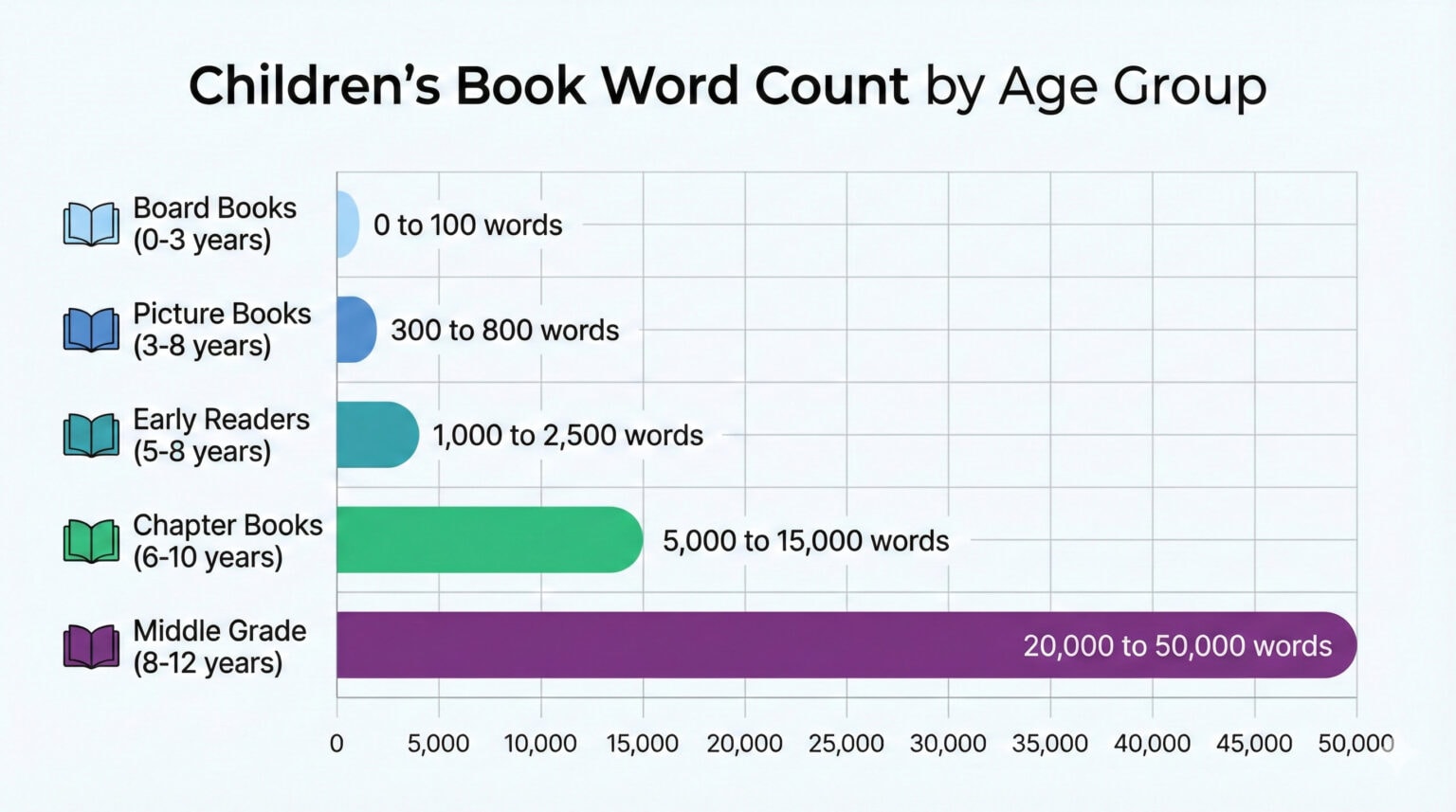
Your manuscript needs to be publication-ready before you invest a single dollar in illustration. That means more than just spell-checking. Children’s books have specific word count expectations based on the reader’s developmental stage. Get this wrong and bookstores will not know how to shelve your book, which means they will not order it at all.
Board books for ages 0 to 3 run 0 to 100 words and focus on simple concepts and rhythm. Picture books for ages 3 to 8 run 300 to 800 words and rely on illustration to carry 60 percent of the story. Early readers for ages 5 to 8 run 1,000 to 2,500 words with controlled vocabulary. Chapter books for ages 6 to 10 run 5,000 to 15,000 words across 8 to 15 short chapters. For this guide I am focusing primarily on picture books, which represent 75 percent of the self-publishing market and require the most specialized production knowledge.
How do you self-edit a children’s book before hiring an editor?
The most important test is the read-aloud test. Read your manuscript out loud 3 to 5 times. If you stumble anywhere, a child being read to will feel it. Pay close attention to rhythm, natural pauses for page turns, and any phrases that feel awkward in spoken form. After that, do a picture walk: go through the manuscript and mark where illustration breaks should fall. Most picture books have 32 pages with 12 to 14 text spreads.
The second test is the show-versus-tell check. In picture books, illustrations do 60 percent of the storytelling. Cut any description that your illustrator can show. If you write “the dragon was enormous with green scales,” that is what the illustration will show. You just need “the dragon appeared.” Every word you remove is a word that leaves room for a better illustration.
What kind of beta readers do children’s books actually need?
Your mom thinks everything you write is brilliant. Your childless friend has no frame of reference. You need three specific types of beta readers. First, 3 to 5 parents of children in your target age group who can tell you whether their child stayed engaged and what confused them. Second, 1 to 2 early childhood educators, because teachers and librarians will catch developmental mismatches that parents miss. Third, if you can find one, a published children’s book author who can spot expensive illustration problems and pacing issues before you spend money on art.
The best places to find qualified beta readers are your local SCBWI chapter (Society of Children’s Book Writers and Illustrators), children’s book groups on Facebook, and library story-time programs where you can speak directly with program coordinators.
Professional line editing for picture books costs $500 to $1,000 and is worth every penny. A skilled line editor will tighten your prose, enhance the rhythm, and sharpen the read-aloud quality in ways that directly affect how parents describe your book to other parents. Skip developmental editing if your beta readers loved the structure, but do not skip line editing.
Step 2: Why Illustration Quality Determines 80% of Your Book's Success
Quick Answer: Professional illustration for a 32-page picture book runs $1,500 to $8,000 depending on the illustrator’s experience level. Mid-level professionals in the $1,500 to $2,500 range deliver consistent quality, unlimited reasonable revisions during the sketch phase, and print-ready files at correct specifications. Budget Fiverr illustrators in the $200 to $800 range frequently deliver low-resolution files, inconsistent character design, and limited revision rights. I have seen authors lose $500 on unusable Fiverr work before coming to a professional. It is not a saving.
Let me be direct: the illustration quality determines 80 percent of your book’s success. Parents buy children’s books based on cover appeal and interior art. A beautifully written story with mediocre illustrations will not sell beyond your immediate network. I say this as both an illustrator and a publisher, not to sell you something, but because it is the truth I have watched play out across 58 published books.
I have illustrated projects for Disney, worked on Microsoft educational content, and won recognition including the Disney Creativity Award in 2002. The difference between a $200 Fiverr illustrator and a $3,000 professional is not a matter of taste. It is a matter of whether your book gets stocked, reviewed, and recommended. Awards, bookstore placement, and school visit invitations all depend on illustration quality. There is no workaround.
What does the professional illustration process actually look like?
The illustration timeline runs 8 to 14 weeks for a 32-page picture book. Weeks 1 to 2 are concept development: character sketches, style samples, color palette discussions, and reference image review. Weeks 3 to 4 are rough sketches in black and white showing every spread, which is where you approve composition and scene interpretation. Changes at this stage are easy. Changes after this stage cost money.
Weeks 5 to 8 are final line art. This is your last opportunity for major revisions without additional costs. Weeks 9 to 12 are full color illustrations, with only minor tweaks available at this point. Weeks 13 to 14 are file preparation, where your illustrator delivers print-ready files at the correct trim size with proper bleed margins and 300 DPI minimum resolution. If your illustrator cannot deliver those specifications, they are not a professional illustrator for print work.
What must your illustration contract include?
Your contract must clearly state that you own all illustration rights including the copyright, the right to reproduce illustrations for marketing, the right to create derivative products such as merchandise, and the right to sell foreign language editions. The illustrator retains portfolio rights to display the work with credit. Watch for red flags: “work for hire with shared rights” is vague and problematic. Any contract with royalty sharing clauses unless you are co-authoring should also raise concerns. I have seen authors unable to create merchandise or foreign editions because of poorly written contracts signed in haste. Do not sign anything without understanding exactly what rights you are receiving.
Want to see what professional illustration looks like for your project?
Already know what you need? View Packages & Pricing, Schedule a Consultation
You can browse recent illustration work in the picture book illustration portfolio.
Step 3: Cream vs White Paper and the Other Technical Decisions You Cannot Undo
This is where self-publishing gets technical, and it is where most amateur books fail. Your files need to meet exact specifications or the printer will reject them. More importantly, certain decisions like trim size and paper type must be made before your illustrator starts work. Change your mind afterward and you may need to recreate all the artwork.
Which trim size is right for a children’s picture book?
Square formats are the modern standard for picture books. 8 by 8 inches is the most popular size on Amazon and looks excellent on bookstore shelves. 8.5 by 8.5 works well for detailed illustrations that need a little more room. Portrait formats like 8 by 10 are the traditional picture book size and work well for tall characters or vertical action sequences. Landscape formats like 10 by 8 are ideal for panoramic scenes or chase sequences where the horizontal space helps the story.
The most important rule: choose your trim size before commissioning illustrations. Changing trim size after artwork is complete means recreating everything. Discuss this with your illustrator during the concept phase so the compositions are designed specifically for the dimensions you have chosen.
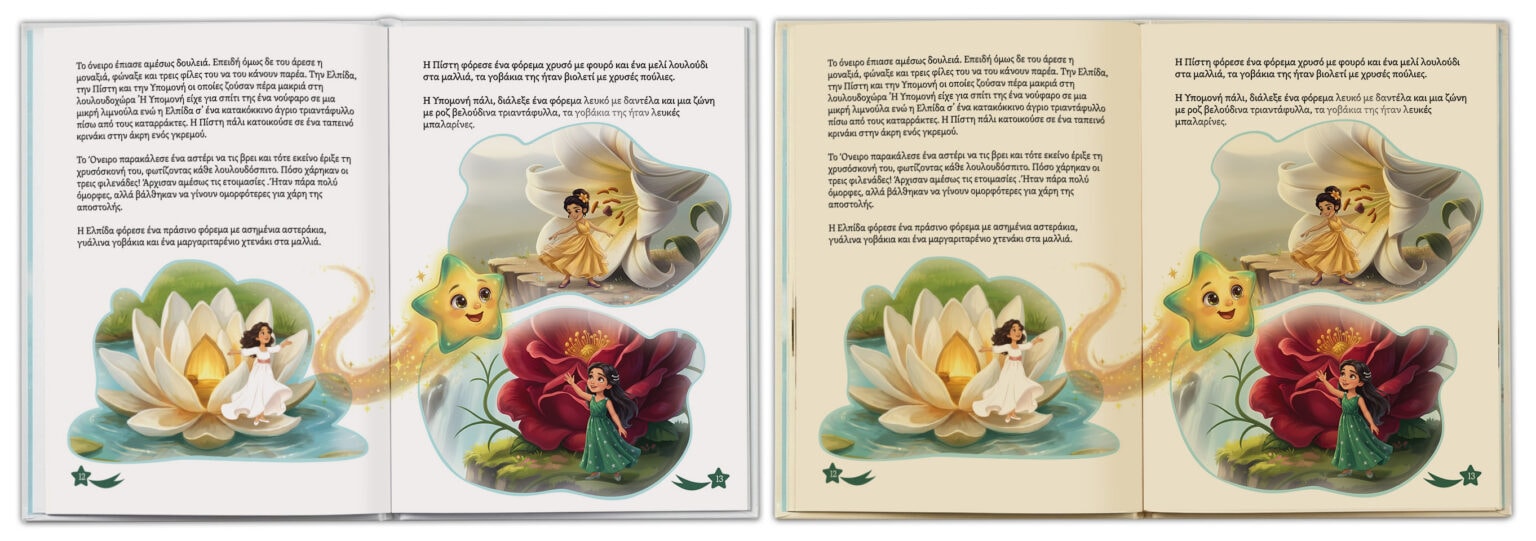
Cream vs white paper: which is right for a children's book?
What resolution and color mode do children’s book files require?
All interior illustrations must be at 300 DPI minimum. IngramSpark strictly enforces this and will reject files below this threshold. KDP accepts lower resolution files but the print quality suffers visibly. For color mode, IngramSpark requires CMYK. KDP accepts RGB but converts it automatically, which can cause unexpected color shifts. The safest approach is to deliver all files in CMYK from the start so both platforms receive exactly what you intended.
Your interior PDF must include a 0.125-inch bleed on all sides, all fonts embedded, and a page count that is an even number. Your cover must be a single continuous PDF covering the front, spine, and back, with the spine width calculated using each platform’s spine calculator tool. Never add a barcode to your cover file. Both KDP and IngramSpark generate and place the barcode automatically during printing.
Step 4: Should You Buy Your Own ISBN or Use the Free One?
Do you need to buy an ISBN to self-publish?
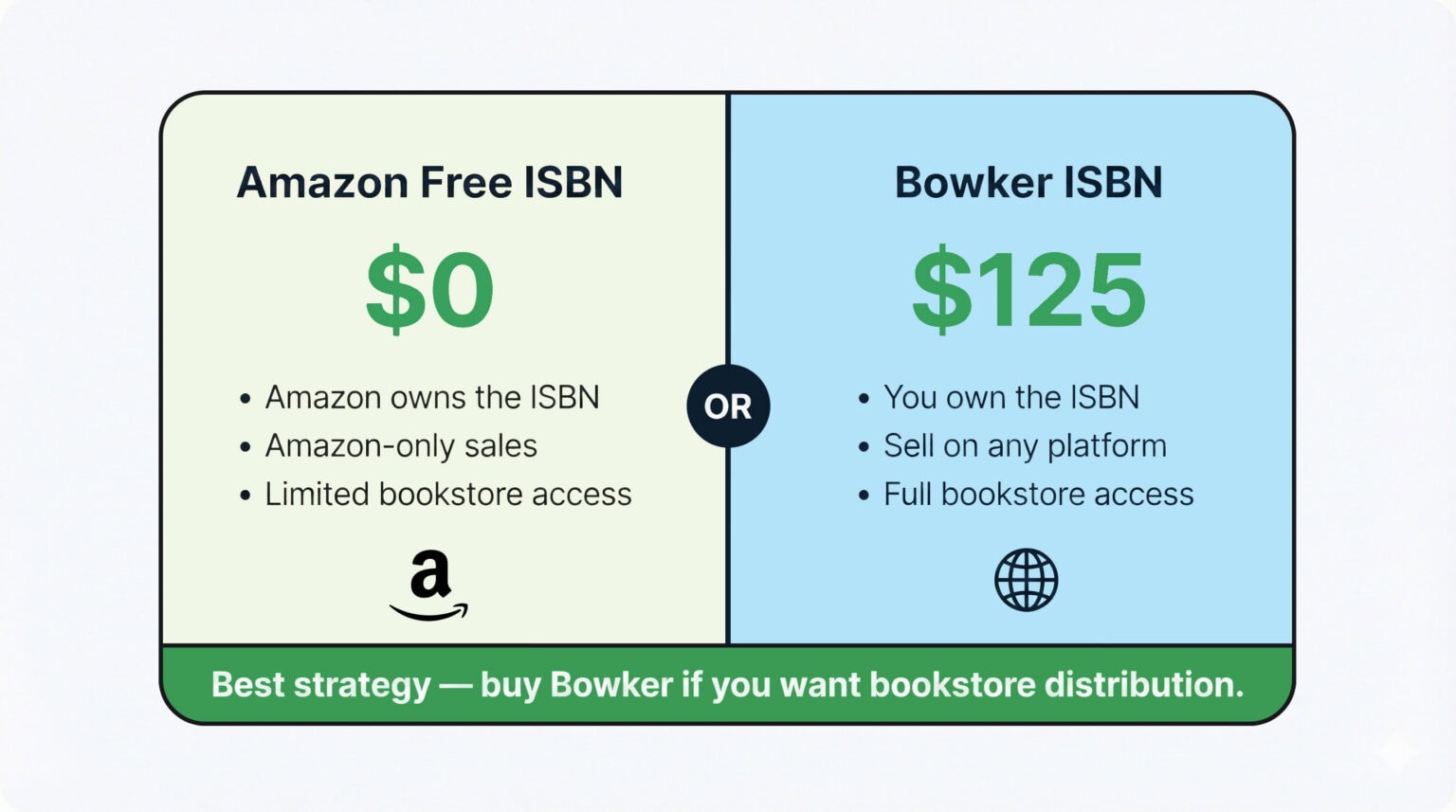
Bowker (myidentifiers.com) is the official ISBN registration agency in the United States. A single ISBN costs $125. A block of 10 costs $295. If you are serious about building a publishing business with multiple books or multiple formats, the block of 10 is the only sensible choice.
Assign a unique ISBN to each distinct edition of your book: one for the KDP paperback, one for the IngramSpark paperback, one for the hardcover, and one for any ebook edition. This gives you clear sales tracking across platforms and the flexibility to update each edition independently without affecting the others.
Your BISAC codes, the category classification codes used by retailers and libraries worldwide, should be chosen at the same stage. Search Amazon for books similar to yours, check their product details for BISAC codes, and choose the most specific code that accurately describes your book. Adding one or two broader codes increases discoverability across different catalog searches.
Step 5: Interior and Cover Formatting
Your manuscript and illustrations are complete, but they are not print-ready until they are professionally formatted. For children’s picture books, interior formatting means designing every spread as a two-page unit because children see both pages at once. Action flows across the gutter. Illustrations can span both pages for dramatic effect. Designing single pages in isolation produces a book that feels disconnected in print.
Typography rules for children’s books differ from adult publishing. Picture books for ages 3 to 6 should use 18 to 24 point fonts. Friendly serif fonts like Century Schoolbook or Garamond work well, as do rounded sans-serifs like Quicksand. Early readers need 14 to 18 point fonts with 1.5x line spacing at minimum. Avoid script or handwriting fonts, condensed fonts, and ultra-thin weight typefaces. For books aimed at children with dyslexia or reading difficulties, the OpenDyslexic font is free, purpose-designed, and increasingly requested by school librarians.
The gutter is the binding edge where pages meet. Keep all text at least 0.5 inches from the gutter. Keep important visual elements, especially character faces, at the same distance. When you receive your proof copy, bend the book open at key spreads and verify that nothing critical disappears into the binding.
Step 6: KDP vs IngramSpark for Children's Books
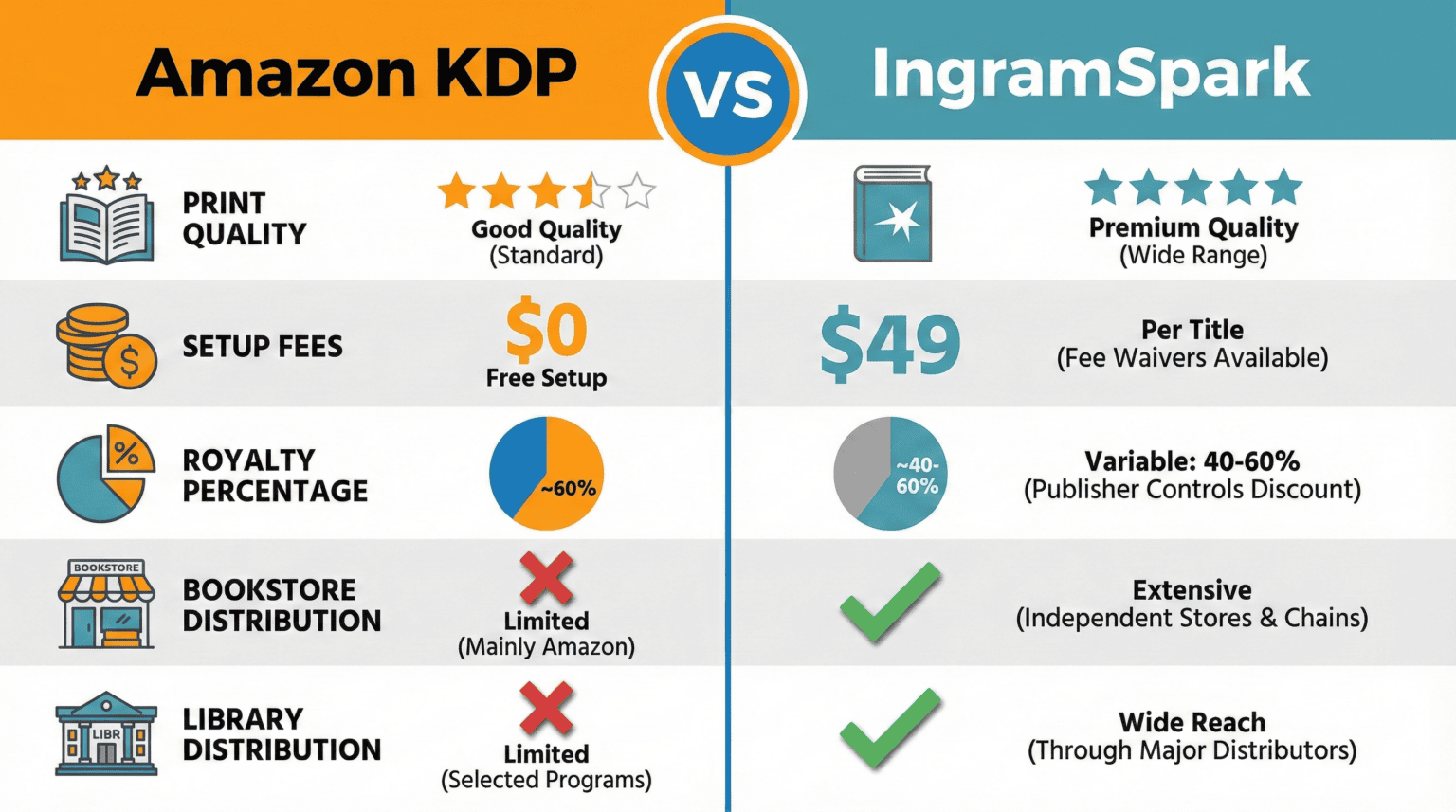
Category | Amazon KDP | IngramSpark |
|---|---|---|
Distribution | Amazon marketplaces worldwide (300M+ customers) | 40,000+ retailers, bookstores, libraries worldwide |
Print Quality | Excellent for paperbacks, 55# paper | Slightly superior CMYK accuracy, dust jacket hardcovers |
Royalty (paperback $12.99) | ~$4.54 per sale | ~$2.10 per sale (at 55% wholesale discount) |
Setup Cost | Free | Free (as of May 2023) |
File Revision Fees | Free, unlimited | $25 per file after 60 days |
ISBN required | No (free KDP ISBN available) | Yes (must own your ISBN) |
Bookstore Stocking | Unlikely (books are non-returnable) | Yes, with 55% discount + returnability |
Hardcover Options | 5 trim sizes, case laminate only, 76+ pages minimum | Many trim sizes, dust jackets available, 18 pages minimum |
Ease of use | Beginner-friendly, clear error messages | Technical, steep learning curve |
File Requirements | Flexible (accepts RGB, converts automatically) | Strict (CMYK required, rejects RGB) |
Best for | Amazon sales volume, beginner setup | Bookstore distribution, library sales, professional credibility |
Can you use both KDP and IngramSpark for the same book?
Yes, and I strongly recommend it. The strategy works like this: use KDP to handle all Amazon sales where you earn the higher royalty per book, and use IngramSpark to handle bookstore and library distribution where the lower per-book royalty is worth the wider physical reach. The one critical rule is that you must not enable KDP Expanded Distribution. When both platforms are active, enabling Expanded Distribution on KDP creates a conflict where both feed your book to Amazon through different terms, and Amazon will select the terms that work against you.
Use separate ISBNs for each platform edition. This gives you clean sales tracking and the flexibility to update each edition independently. Import critical setting: on IngramSpark, set your wholesale discount to 55 percent and mark the book as returnable. Without those two settings, physical bookstores will not order your book regardless of how good it is.
Step 7: Uploading Your Book and Ordering Proof Copies
The KDP upload process is genuinely beginner-friendly. Create your account, enter title details, upload your interior PDF, upload your cover PDF, set your royalty structure, and submit. File revisions are free and unlimited. Proof copies cost $2 to $10 plus shipping and arrive in 5 to 7 days. The whole setup from account creation to submission takes 2 to 4 hours for a prepared author with finished files.
The IngramSpark upload process is more technical and less forgiving. Your interior file must be PDF only, exactly the right trim size with 0.125-inch bleed on all sides, 300 DPI, CMYK color mode, all fonts embedded. Your cover must be a single PDF with the spine width calculated precisely using their spine calculator tool. The automated file check takes 5 to 30 minutes and will list every error it finds. Common rejections include RGB color mode, resolution below 300 DPI, incorrect bleed dimensions, and spine width mismatches. Each of these has a specific fix, and IngramSpark’s help center contains detailed articles for each error type.
Why should you never skip ordering physical proof copies?
Even with technically perfect digital files, print can reveal issues that a screen cannot show you. Colors may appear more saturated or more muted than expected. Text near the gutter may disappear into the binding. Bleed may not extend fully to the trimmed edge, leaving a thin white border. The cover spine text may be slightly off-center. None of these issues are visible on a monitor. All of them are visible the moment you hold the printed book in your hands.
Order 2 to 3 proof copies. Review one yourself, give one to a beta reader, and keep one as your first-edition proof. On KDP, proof copies cost $2 to $10 plus shipping. On IngramSpark, you pay the retail price plus shipping, which runs $20 to $40 total for a picture book, but the print quality of IngramSpark proofs is the quality your bookstore customers will receive, which makes the higher cost worthwhile.
Step 8: How to Price Your Children's Book for Maximum Profit
Format | Market Range | Self-Published Sweet Spot | KDP Royalty at Sweet Spot |
|---|---|---|---|
Board book (18-24 pages) | $6.99 to $14.99 | $8.99 to $9.99 | ~$2.15 per sale |
Paperback picture book (32 pages) | $8.99 to $18.99 | $11.99 to $13.99 | ~$3.94 to $5.09 per sale |
Hardcover picture book (32 pages) | $14.99 to $24.99+ | $16.99 to $18.99 | ~$5.59 to $6.59 per sale
|
Pricing too low is one of the most common and most harmful mistakes in children’s book self-publishing. Parents associate price with quality. A picture book at $7.99 signals to a parent browsing Amazon that something is off. It does not drive more impulse purchases. It signals amateur production. The $11.99 to $13.99 range is the considered-purchase territory where parents buying for birthdays or building a home library feel comfortable spending.
What royalty can you expect from a self-published children's book?
Quick Answer: At a $12.99 retail price on KDP, you earn approximately $4.54 per sale after printing costs. At $15.99 you earn approximately $6.34. On IngramSpark with a 55 percent wholesale discount, those numbers drop to roughly $2.10 and $3.41 respectively. This is why the dual-platform strategy matters: you earn KDP’s higher royalty on every Amazon sale while IngramSpark’s lower royalty buys you access to 40,000 retailers and library systems that Amazon will never reach.
Step 9: How to Market a Children's Book After Launch
Publishing your book is half the battle. Discoverability requires deliberate effort, and the most effective marketing for children’s books happens through channels that most first-time authors ignore entirely.
Start your Amazon listing optimization before you submit for publication. Your book description is both a sales pitch and an SEO tool. Structure it with a hook line, a story premise in 2 to 3 sentences, the emotional benefit for the parent and child, the target age range, and a brief author credential. Use your seven Amazon keyword slots for specific character types, themes, age descriptors, and format descriptors. Do not waste keyword slots on your own title, author name, or generic words like “book” or “fiction.”
For bookstore sales, schools and libraries are the most valuable channels for children’s books. Once your book is in the IngramSpark catalog, libraries can order through Baker and Taylor. Pitch to your local library system directly with a review copy and a brief author bio. Create an educator guide with discussion questions and activity sheets, which gives school librarians a reason to purchase. Author school visits earn $200 to $500 per visit for new authors, which builds both income and a local reader base that generates word-of-mouth reviews.
Build your email list before launch. Email subscribers are 10 times more valuable than social media followers because you own that communication channel. Offer a lead magnet, a free printable coloring page, an activity sheet related to your book, or a behind-the-scenes illustration guide. Your goal is 100 subscribers before publication day. These are your launch team and your first review requestors.
Step 10: What to Do After Your Book Is Published
Amazon reviews are the single most important post-launch priority. Books with 0 to 10 reviews convert poorly. At 25 to 50 reviews, you have meaningful social proof that influences undecided parents. The ethical way to gather reviews is to email every buyer directly and ask for an honest review. Do not ask for five stars. Do not incentivize reviews. Do not ask family members at the same IP address to review. Amazon tracks these patterns and will remove reviews or suspend accounts.
Track sales across both platforms from day one. KDP updates daily. IngramSpark updates monthly with a 60 to 90 day lag. Build a simple spreadsheet tracking date, platform, units sold, and royalty earned. After 100 sales, you will have enough data to evaluate your pricing, identify which platform is driving volume, and make informed decisions about whether to run launch promotions or adjust your category selections.
If your book succeeds, plan your series. Readers who love one book in a series automatically buy the next. Amazon’s algorithm connects books in a series through its recommendations engine. Aim for a release schedule of one new book per year minimum to maintain momentum and keep your backlist visible.
Key Takeaways: About How to Self-Publish a Children's Book Successfully
- Professional illustration drives 80 percent of your book’s commercial success. Budget $1,500 to $3,000 minimum for a 32-page picture book and do not treat this as a place to cut costs.
- Choose your trim size and paper type before commissioning any artwork. These decisions cannot be undone without recreating the illustrations.
- Buy your ISBNs from Bowker. Use your own ISBN on both platforms so you are listed as the publisher of record across every catalog.
- Use KDP for Amazon sales and IngramSpark for bookstore and library distribution. Never enable KDP Expanded Distribution when running both simultaneously.
- Set IngramSpark’s wholesale discount to 55 percent and mark the book as returnable. Without these settings, physical bookstores will not stock your book.
- All files must be 300 DPI minimum and CMYK color mode. IngramSpark enforces both strictly and will reject non-compliant uploads.
- Order physical proof copies from both platforms and review them in hand before going live. Screen review is not sufficient.
- Price paperback picture books at $11.99 to $13.99. Pricing below this range signals amateur production and reduces conversion rates.
- Build your email list before launch. Social media reach is rented. Email is owned.
- The typical first book sells 200 to 800 copies in year one. Sustainable author income builds across a 3 to 5 book catalog, not from a single title.
Publishing your book is the beginning, not the end. The children’s book marketing guide covers the full 90-day launch campaign, Amazon ads, email lists, and the review strategy that activates the algorithm.
FAQ About How to Self-Publish a Children's Book Successfully
How much does it cost to self-publish a children's book?
Quick Answer: A professionally produced children’s book costs between $3,800 and $10,375 all in. The main variables are illustration quality ($1,500 to $5,000), professional editing ($500 to $2,000), interior and cover formatting ($300 to $800), ISBNs and platform setup ($0 to $575), and pre-launch marketing ($500 to $2,000). Illustration is the single largest cost and the one you should invest in most heavily, since it drives the majority of your sales and review quality.
Is self-publishing or traditional publishing better for a children's book?
What trim size should I choose for a picture book?
The most popular trim size for modern picture books is 8 by 8 inches square, which works well on Amazon listings and bookstore shelves. If your story features tall characters or vertical action, 8 by 10 portrait is the traditional choice. If your story involves wide panoramic scenes, 10 by 8 landscape creates strong visual impact. The critical rule is to decide before commissioning illustrations, because changing trim size afterward means recreating the artwork entirely.
What is the difference between cream and white paper for children's books?
White paper produces more vibrant, saturated colors and suits modern digital illustration styles with clean backgrounds and bold palettes. Cream paper suits classic or painterly illustration styles with warm tonal ranges, and creates a softer, more nostalgic reading feel. Most modern color picture books use white paper. If your illustrations were created with a warm, earthy, or vintage aesthetic, cream paper will enhance that mood. If they were created digitally with bright primaries and clean whites, cream paper will muffle the colors rather than complement them.
Do you need an LLC to self-publish a children's book?
You do not need an LLC to self-publish. You can publish as a sole proprietor under your own name. However, if you are publishing under an imprint name, taking on school visit contracts, or building a multi-book catalog, setting up an LLC provides liability separation and makes your business banking cleaner. Consult an accountant rather than making this decision based on general advice, since the right structure depends on your income level and the jurisdiction you are operating in.
What files do you need to submit to KDP and IngramSpark?
Both platforms require an interior PDF and a cover PDF. The interior PDF must include the trim size plus 0.125-inch bleed on all sides, 300 DPI resolution, all fonts embedded, and an even page count. The cover PDF must be a single continuous file covering the front cover, spine, and back cover, with the spine width calculated using each platform’s spine width calculator. KDP accepts both RGB and CMYK color modes. IngramSpark requires CMYK strictly and will reject RGB files. Do not add a barcode to your cover file on either platform.
How do you get a children's book into bookstores?
Getting into bookstores requires an IngramSpark listing with a 55 percent wholesale discount and returnable status enabled. This combination meets the standard terms that physical bookstores require before they will place an order. Once your book is live in the Ingram catalog, independent bookstores can order it through their standard purchasing process. To increase the likelihood of stocking, send a physical review copy to the children’s buyer at your target stores with a personal note about your book’s audience. Bookstores are far more likely to stock locally authored books when there is a direct relationship with the author.
Can you sell a children's book on both KDP and IngramSpark at the same time?
Yes, and it is the recommended strategy. Use KDP for all Amazon sales, where you earn approximately $4.54 per sale on a $12.99 paperback. Use IngramSpark for all bookstore, library, and non-Amazon retailer distribution. Use separate ISBNs for each platform edition so you can update them independently. The one critical setting: do not enable KDP Expanded Distribution when running both platforms, as this creates a conflict where both services feed your book to Amazon with different terms and Amazon will select the worse deal for you.
How do you market a self-published children's book?
The highest-return marketing activities for children’s book authors are building an email list before launch (aim for 100 subscribers), sending advance review copies to 20 to 30 children’s book bloggers and educators, pursuing school visit opportunities through your local school district, and requesting honest Amazon reviews from everyone who purchases. Social media accounts on Instagram, Facebook, or TikTok support discoverability but are supplementary rather than primary marketing channels. The authors who build sustainable businesses invest in their email list and school visit network above all other marketing activities.
Why Authors Choose ReadnLearn for Their Publishing Journey
I have walked you through the entire self-publishing process in detail because I believe authors deserve to understand what they are getting into before they spend money. But I also know that the technical complexity of this process is overwhelming for most first-time authors, and that is exactly why I created the illustration and publishing packages at ReadnLearn.
Package | What Is Included | Timeline | Investment |
|---|---|---|---|
Professional Illustration | Manuscript review, character design (3 revision rounds), 12 to 14 full-spread color illustrations, front and back cover, print-ready files for KDP and IngramSpark, full rights ownership, source files, one year of revision support | 10 to 14 weeks | $3,200 |
Full Publishing Package | Everything in Illustration Package, plus: interior and cover formatting, Bowker ISBN registration, BISAC code research, metadata optimization, KDP setup and upload, IngramSpark setup and upload, proof coordination and revisions, 1-hour marketing consultation | 14 to 18 weeks | Coming Soon |
Educational Content Add-On | Teacher and parent discussion guide, activity sheets, classroom curriculum tie-in, STEM/STEAM connection guide where applicable | 3 to 4 weeks | $1200
|
Ready to see what professional illustration looks like for your specific story?
I illustrate one spread from your manuscript at no cost.
You see the quality before committing to anything. No commitment required,
Available for a limited time
About the Author
Aris is a children’s book illustrator and educational content creator based in Athens, Greece. With 27 years of experience and 58+ published books, he has received the Disney Creativity Award in 2002 and was selected for Microsoft AppCampus funding in 2014.
ReadnLearn operates on a dual mission: providing professional illustration and publishing services to international authors while using that revenue to fund the development of free educational tools and therapeutic resources for children with autism and other learning differences. To request a free custom spread illustration or ask about available services, visit the services page or submit a request directly.
