
Children's Book Marketing: Complete Success Guide for Self-Published Authors (2026
Quick Answer: Children’s book marketing requires a 3-phase approach: build an audience 60-90 days before launch, execute a coordinated 90-day launch campaign, then sustain momentum through evergreen systems. Amazon ads, email lists, and reviews are the three highest-ROI channels. This guide synthesizes strategies from 50+ successful self-published authors so you can skip the guesswork.

You have poured your heart into creating a beautiful children’s book. The illustrations are vibrant, the story resonates, the message matters. But here is the reality most first-time authors discover too late: creating an excellent book is only half the battle. Marketing that book to the readers who will love it? That is where the real challenge begins.
I will be transparent from the start: I am currently illustrating my own first children’s book and have not yet launched it. Like you, I am navigating the complex world of children’s book marketing. But here is what I have done: I analyzed marketing strategies from more than 50 successful children’s book authors, studied industry data, examined what is working in 2026, and documented the proven frameworks authors are using right now to sell thousands of copies.
This is not “my proven system.” It is a comprehensive research synthesis of what successful authors are doing, backed by data from Google Ads, industry reports, and real campaign results. Think of this guide as your research partner. I have done the heavy lifting so you can implement proven strategies rather than guess your way through the marketing maze.
Every illustration project I take on at ReadnLearn helps fund development of autism-friendly educational apps and resources. Part of that mission is giving children’s book authors the tools they need to succeed, which is why this research guide exists.
This guide targets the fastest-growing marketing keywords that authors are searching for in 2026: “book launch strategy” (up 2000% yearly), “Amazon KDP marketing” (up 750%), and “amazon book ads” (720 monthly searches). Let’s get into what actually works.
What Are the Marketing Fundamentals Every Children's Book Author Needs?
Quick Answer: Children’s book marketing has one unique challenge other books do not: you are marketing to adults who buy for children. Parents, grandparents, teachers, and librarians make the purchase decisions. Every marketing message, every ad, every social post must speak to the adult buyer while showcasing content kids will love. This dual-audience dynamic shapes every strategy in this guide.
Before you can market effectively, the illustration quality has to hold up at thumbnail size. Read about how to hire a picture book illustrator to understand what separates professional from amateur results, and if you are stuck comparing candidates, how to choose an illustrator without regret explains why that happens and how to break the tie.
The Dual-Audience Challenge
Your readers are children, but your buyers are parents (primarily mothers, age 25-45), grandparents, teachers, and gift-givers. Research from Scholastic shows 73% of parents read aloud to children before age 1, and 57% continue through age 8. Your marketing must resonate with adults while showcasing content that appeals to children. Social media content targets parents. Book descriptions emphasize developmental benefits. Reviews come from adults who have read to children. Amazon ads target parenting keywords, not character names.
What Realistic Success Looks Like
Performance Tier | Year 1 Sales | Reviews | What It Means |
|---|---|---|---|
Bronze (Solid first book) | 500-1,000 | 15+ | Recovered most production costs
|
Silver (Strong performance) | 1,000-3,000 | 30+ | Profitable, invitations for events
|
Gold (Exceptional) | 3,000-10,000 | 50+ | Multiple revenue streams, sustainable author business
|
Platinum (Top 1%) | 10,000+ | 100+ | Full-time income potential, publisher interest
|
The Marketing Mindset Shift
Successful author marketing requires shifting from “creator mindset” to “promoter mindset,” and for most illustrators and writers, this is the hardest part. Marketing is not salesy or uncomfortable when you reframe it correctly: marketing is service. You are helping the right readers discover content they will genuinely value. Your book is beautiful, and it is your job to actively connect it with the audience who will love it.
The authors who surpass average benchmarks share common traits: they built a pre-launch email list of 100+ subscribers, they maintained consistent social media presence for 6+ months before publishing, they used at least 2 paid marketing channels, and they invested in professional cover design and interior illustrations. Quality matters, but quality without marketing leaves excellent books undiscovered.
How Do You Build Pre-Launch Marketing Momentum?
Quick Answer: Start your children’s book marketing 60-90 days before publication. Books launched with pre-built anticipation (email list, advance reviews, social media following) sell 3-5x more copies in the first month than books marketed starting on launch day. The three pre-launch priorities are your email list, advance review copies (ARCs), and your optimized Amazon product page.
Why Pre-Launch Marketing Changes Everything
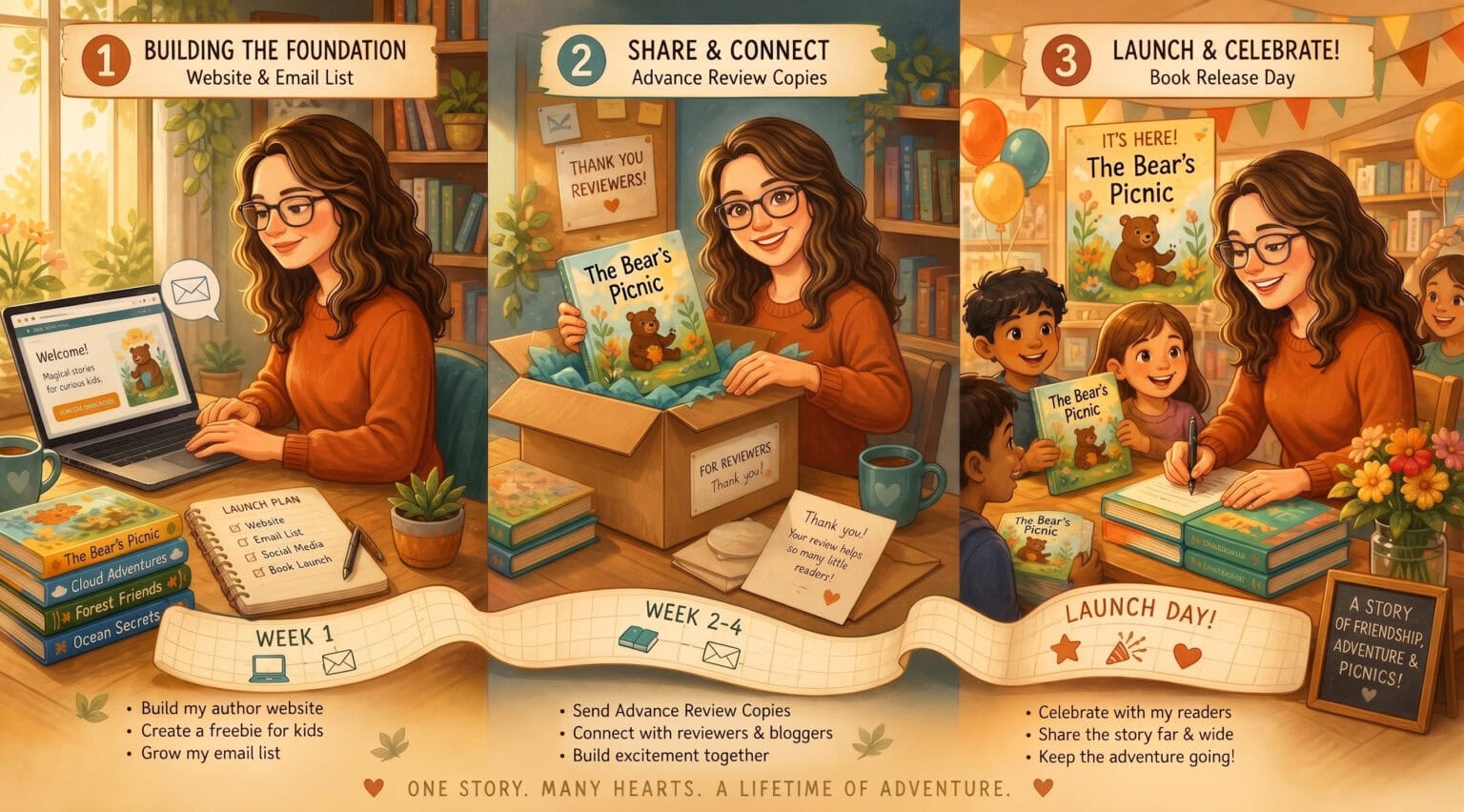
Most authors wait until publication day to start marketing. Research consistently shows this is the most costly mistake a self-published author can make. Launch day with zero audience is like opening a store with no foot traffic. Launch day with 100 email subscribers, 10-15 reviews, and an optimized Amazon listing is launch day with momentum. The difference in first-month sales between these two scenarios is 3-5x, and that early momentum feeds the Amazon algorithm for months afterward.
The 90-Day Pre-Launch Timeline
Days 1-30: Foundation Building
Set up your author website and email marketing service. Create your lead magnet (a free resource parents will exchange their email address for). Good options include printable coloring pages of your characters, activity sheets related to your book theme, or a read-aloud guide for parents. Launch your lead magnet on social media. Set up your email welcome sequence. Begin posting on 1-2 social media platforms.
Days 31-60: Audience Building
Ramp up social media posting to 4-5 times per week. Share behind-the-scenes content from the illustration process. Start identifying ARC (Advance Review Copy) readers: friends and family with children, parent bloggers, children’s book reviewers on Instagram. Create an ARC application or outreach template. Send your first ARCs with clear expectations: an honest review by launch date, no payment required.
Days 61-90: Launch Preparation
Confirm all ARC readers have copies. Set up Amazon Author Central. Finalize your Amazon categories and backend keywords. Create your Amazon ad campaigns (ready to activate on launch day). Write your launch week email sequence. Build your social media content calendar for launch week. Send ARC readers a gentle reminder that review-posting day is approaching.
Building Your Email List from Zero
Email marketing converts to book sales at 5-10x the rate of social media, yet 60% of self-published authors do not have an email list at launch. Start building yours the day you commit to publishing. Your lead magnet should be something genuinely useful to parents: a printable activity pack, a reading guide, or character coloring pages. If your lead magnet is an activity pack or educational worksheet, see how to structure activity books for kids so the freebie matches professional quality. Promote it consistently and follow up with a 3-email welcome sequence that delivers the freebie, shares your author story, and builds anticipation for your book.
Platform recommendations: MailerLite is free up to 1,000 subscribers and has strong automation features. ConvertKit is author-focused and worth upgrading to at 500+ subscribers. Both integrate easily with WordPress. Do not wait until you have a polished list to start sending. An imperfect email to 50 engaged people beats a perfect email sent to no one.
Securing Advance Reviews Before Launch
Target 10-20 advance review copies before launch day. Start with your personal network: friends and family with young children in your book’s target age range. Reach out personally, send a PDF, and ask for an honest review by your launch date. Expect 40-60% to actually follow through. Then move to book reviewers and parent bloggers on Instagram (search #kidlitreviewer). Send ARCs 4-6 weeks before launch to give reviewers enough time to read and write their reviews.
For a professional approach with budget, SCBWI (Society of Children’s Book Writers and Illustrators) has networks of reviewers and fellow authors who support debut books. NetGalley ($450 for 4 months) connects you with librarians and educators and is worth considering if your book has broad institutional appeal.
How Do You Execute a Successful 90-Day Book Launch?
Quick Answer:A book launch is not a single day. It is a 90-day strategic window with three phases: launch week (maximum intensity), early momentum (days 8-30), and sustained growth (days 31-90). The biggest mistake authors make is treating launch week as the finish line. The authors who sell consistently treat it as the starting gun.
Launch Week Execution (Days 1-7)
Launch day is coordinated and intentional. In the morning: publish to Amazon KDP, send your primary email announcement, post across all social platforms, and activate your Amazon ad campaigns. In the afternoon: personal outreach to close friends and family via direct message (not public posts), engage with every comment. In the evening: post a “thank you” and share any early reader reactions. The energy on launch day sets the social proof tone for everything that follows.
Your launch week email sequence should run 5-7 emails over 7 days. Email 1 is the launch announcement with a clear buy link. Email 2 is your personal story about why you wrote this book. Email 3 shares early reviews and social proof. Email 4 delivers bonus content (activity sheets, discussion guide). Email 5-6 create gentle urgency if you have a launch-week offer. Email 7 says thank you and invites ongoing connection. This sequence converts 2-3x better than a single launch announcement.
Building Momentum (Days 8-30)
The second and third weeks are critical. Continue posting 4-6 times per week on social media. Focus heavily on review generation: email buyers with a direct Amazon review link, follow up with ARC readers who have not posted yet. Your goal is to reach 15-20 total reviews by the end of the first month. This threshold matters because Amazon’s algorithm begins recommending books that cross it. Authors with 15-20 reviews see 2-3x better organic discovery than those with fewer than 10.
Sustained Growth (Days 31-90)
By day 30, you have data. Which marketing channel drove the most sales? Which Amazon ad keywords are converting? Which social media platform has the highest engagement? This is the optimization phase. Allocate 70% of your budget to what is working, and test new approaches with the remaining 30%. Begin school and library outreach now, using a professional one-sheet with your book details, author bio, and contact information.
Ready to Create the Book You Will Be Marketing?
Before you can market a children’s book, you need one worth marketing. I create Modern Disney-Style Digital Illustrations that give books the professional quality they need to compete in today’s market. Get a free custom spread to see what is possible with no credit card and no obligation.
You can browse recent illustration work in the picture book illustration portfolio.
How Do You Use Amazon KDP to Market Your Children's Book?
Quick Answer: Amazon accounts for 65-75% of total sales for most self-published children’s books. Mastering Amazon means optimizing your product page first (title, description, categories, keywords, A+ content), then running Sponsored Products ads after you have 10-15 reviews. Authors who optimize their Amazon presence before advertising see 3-4x better ROI than those who jump straight to ads.

Optimizing Your Amazon Product Page
Your Amazon product page is your number one sales tool. The title should include your primary keyword naturally, follow this format: “Main Title: Compelling Subtitle with Keywords (Ages X-X)”, and use the full 200-character limit. Your description should open with a hook that speaks to the parent’s concern or the child’s desire in the first two sentences. Structure the description with a story summary, what the child will learn, who it is perfect for, and a clear call to action. Category selection is strategic, not random. Your seven categories should balance one or two competitive broad categories (more visibility) with three to five niche subcategories where top-100 ranking is achievable with 5-10 sales per week. Search Amazon for similar books, check their “Product Details” section, and target categories where bestseller ranks are under 100,000. Request category changes through KDP support if needed, and test different combinations during launch week.How Do Amazon Keyword Research and Backend Keywords Work?
Your seven backend keyword boxes (50 characters each) are invisible to buyers but critical for search visibility. Research shows authors who optimize keywords see 40-60% more organic discovery. Use long-tail phrases buyers actually search: “books about starting school for 4 year olds” rather than just “school.” Include age-specific terms: “kindergarten reading level books,” “books for 3 year old boys.” Use the Amazon search autocomplete to find real search patterns. Do not repeat words from your title (wasted space) and avoid competitor names.Amazon Advertising Strategy
Wait until you have 10-15 reviews before spending on Amazon ads. Running ads with fewer reviews wastes budget because clicks arrive at a product page that does not convert. Start with one Sponsored Products campaign on automatic targeting at a $5-10/day budget. Let it run for 100+ clicks before making changes. Download the search term report weekly. After 30 days, create a manual campaign using your best-performing keywords from the automatic campaign. The average cost per click for children’s book ads runs $0.15-$0.45 with conversion rates of 8-15%.Budget Level | Daily Spend | Campaign Type | Expected Outcome |
|---|---|---|---|
Testing | $5 / day | Automatic only | Data collection, find winning keywords
|
Moderate | $10-15 / day | Auto + Manual | Sustained visibility during launch |
Aggressive (Launch) | $20-30 / day | Auto + Manual + Product Targeting | Bestseller rank push, maximum visibility
|
Maintenance | $3-5 / day | Manual (proven keywords only) | Algorithm signal + visibility, break-even ROI
|
Which Social Media Platforms Work Best for Children's Book Marketing?
Quick Answer: Instagram is the strongest single platform for children’s book authors because it is visual, the parent demographic (moms 25-40) is highly active, and Reels drive strong discovery. Do not try to be everywhere. Authors who focus on 1-2 platforms consistently outperform those who spread thin across 5+. Choose based on where your target buyers spend their time, not where you feel most comfortable.
How to Choose the Right Platform
Platform | Best For | Time/Week | Direct Sales Effectiveness |
|---|---|---|---|
Instagram | Picture books, illustration showcase, parents 25-40 | 3-5 hours | Low direct, high for audience/list building |
Facebook | Community, groups, parents 30-50 | 2-3 hours | Moderate through group engagement |
Pinterest | Long-tail discovery, evergreen traffic to website | 2-3 hours | Low direct, high for website traffic |
TikTok | Authors comfortable on camera, viral potential | 3-5 hours | Low to moderate direct sales
|
YouTube | Read-alouds, long-term authority building | 4-6 hours | Low direct, high for long-term audience |
Content Strategy That Does Not Feel Like Selling
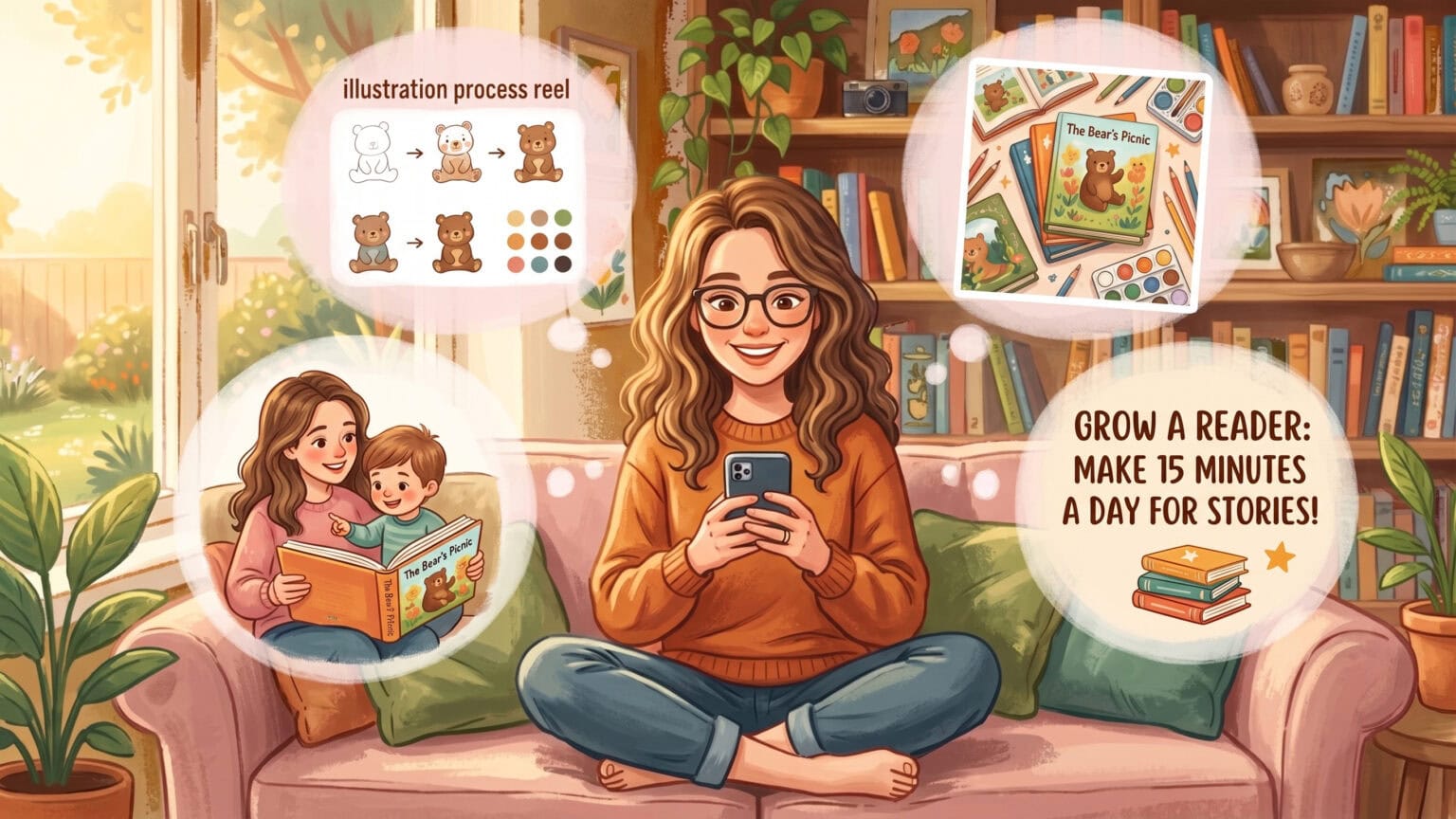
Social media rarely drives direct book sales for children’s authors. Its real value is building relationships and growing email lists. The 80/20 content rule applies here: 80% of posts should provide value (behind-the-scenes illustration process, parenting tips related to your book’s themes, book recommendations, activity ideas), and only 20% should be promotional. Authors who post “buy my book” daily build nothing. Authors who share genuine value consistently build audiences who buy when asked.
Spend 15-20 minutes daily engaging with other creators’ content before posting your own. Comment meaningfully on 10-15 posts from similar authors, parents, and teachers. Reply to every comment on your posts within the first hour. Engagement is reciprocal. This approach consistently generates 20-50 new genuine followers per week, which is more valuable than any follower-count growth hack.
How Does Email Marketing Drive Children's Book Sales?
Quick Answer: Email is the highest-converting marketing channel for book sales, yet 60% of self-published authors launch without one. Authors with 300 engaged email subscribers consistently sell more books than authors with 3,000 social media followers and no list. Email open rates average 30-40% versus 2-5% organic reach on social. You own your email list. Platform changes cannot take it from you.
Building Your List from Zero
Create a lead magnet that your target readers (parents and teachers) genuinely want. For children’s book authors, the most effective lead magnets are printable activity packs related to your book theme, reading tip guides for parents, character coloring pages, or educational worksheets. Promote it consistently in your social media bio link, on your website, and in every author bio you write. Add a pop-up and footer signup form to your website. The first 100 subscribers take the longest (4-8 weeks typically), then growth accelerates.
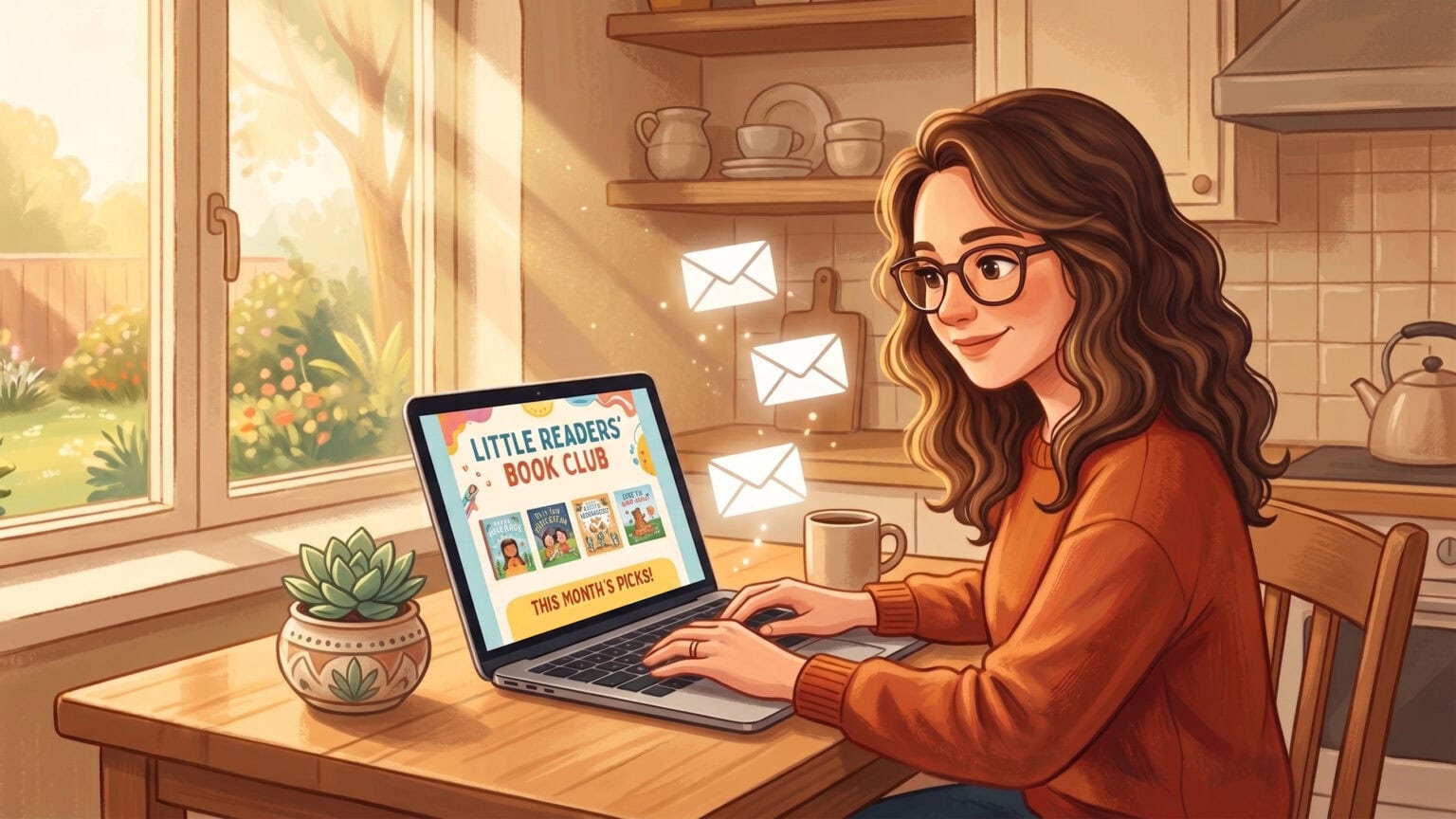
Set up a 5-7 email welcome sequence that activates the moment someone subscribes. Email 1 delivers the freebie immediately. Email 2 (day 2) tells your author story. Email 3 (day 4) provides additional value. Email 4 (day 7) introduces your book softly. Email 5 (day 10) shares behind-the-scenes content. Email 6 (day 14) invites ongoing engagement and offers a subscriber benefit. This sequence has 50-70% open rates, the highest of any email you will ever send.
How Often Should You Email Your List?
Research shows authors who email weekly sell 2-3x more books than those who email monthly. The recommended cadence is weekly with an 80/20 value split: four value emails (book recommendations, parenting tips, behind-the-scenes, reader spotlights) for every one promotional email (sale, launch announcement, review request). Consistency matters more than frequency. A weekly email you can maintain for 12 months beats a daily burst that stops after three weeks.
Need Professional Illustrations Before You Can Market?
Marketing a poorly illustrated children’s book is an uphill battle. I specialize in Modern Disney-Style Digital Illustration with 27 years of experience and 58+ published books. See what your characters could look like before you commit.
You can browse recent illustration work in the picture book illustration portfolio.
How Do You Get Reviews and Build Social Proof for Your Children's Book?
Quick Answer: Books with 15+ reviews sell 3-4x more copies than books with fewer than 10, even when the cover, description, and price are identical. Amazon’s algorithm weights reviews heavily. Getting reviews for children’s books is harder than adult books because parents rarely review and children cannot. You need a systematic review generation strategy from day one, not a hopeful approach.
The ARC Strategy That Actually Works
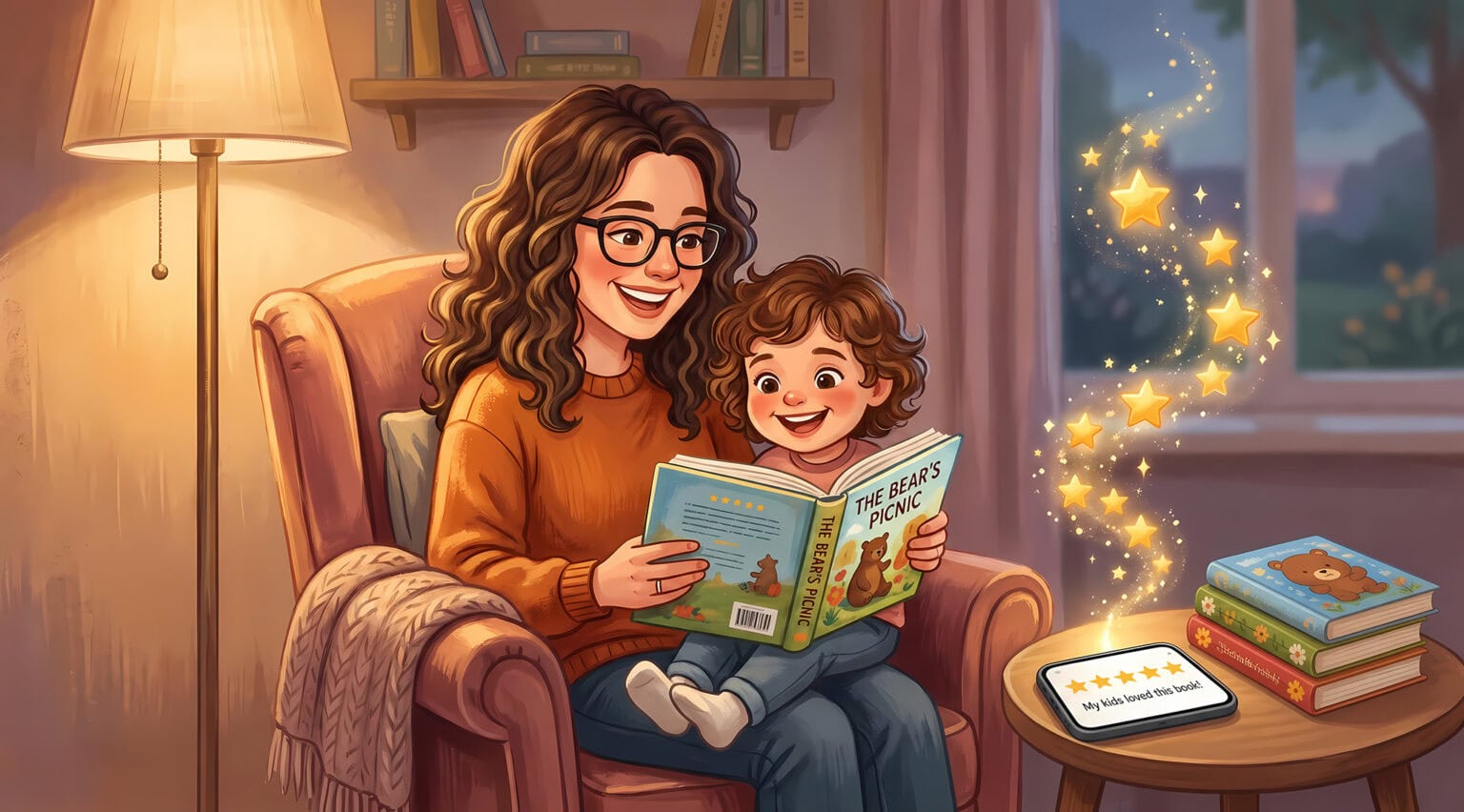
Target 20-50 Advance Review Copies distributed 4-6 weeks before your launch date. Start with your personal network (friends and family with children in your target age range). Expect 40-60% to actually post a review. Then reach out to parent bloggers and Instagram reviewers (search #kidlitreviewer, #childrensbooks). Provide a simple one-page review request letter with your book’s Amazon link, the target audience age, and a deadline. Thank everyone who reviews, including those who leave critical feedback.
For budget-conscious authors, BookSirens ($20-50) and BookSprout ($20-50) are platforms that connect authors with readers who commit to reviewing in exchange for a free advance copy. Expect 50-70% follow-through. Run these 30-60 days before launch and expect 10-30 reviews from 50-100 distributed copies. This investment often delivers the 10-15 reviews needed to activate Amazon ads effectively.
The Systematic Review Request Sequence
Use Amazon’s built-in “Request a Review” button in your KDP dashboard for every eligible order (available 5-30 days after delivery). This converts at 5-10%. Set a weekly reminder to do this for all eligible orders. For readers you can contact directly, a personalized email asking for an honest review 2-3 weeks after delivery converts at 10-15%. Keep it brief: thank them for purchasing, ask if they would share two honest sentences on Amazon, include the direct review link. Never offer compensation for reviews, as this violates Amazon’s terms.
What Is the Long-Term Marketing Strategy for a Children's Book?
Quick Answer: Research shows 70% of total lifetime book sales happen after the first 90 days. Authors who treat marketing as a 90-day sprint burn out. The authors still selling books 3-5 years post-publication built sustainable systems: a weekly email, consistent social presence, quarterly ad optimization, and a series that makes each new book market all previous books. Long-term marketing is less about effort and more about systems.
School and Library Marketing
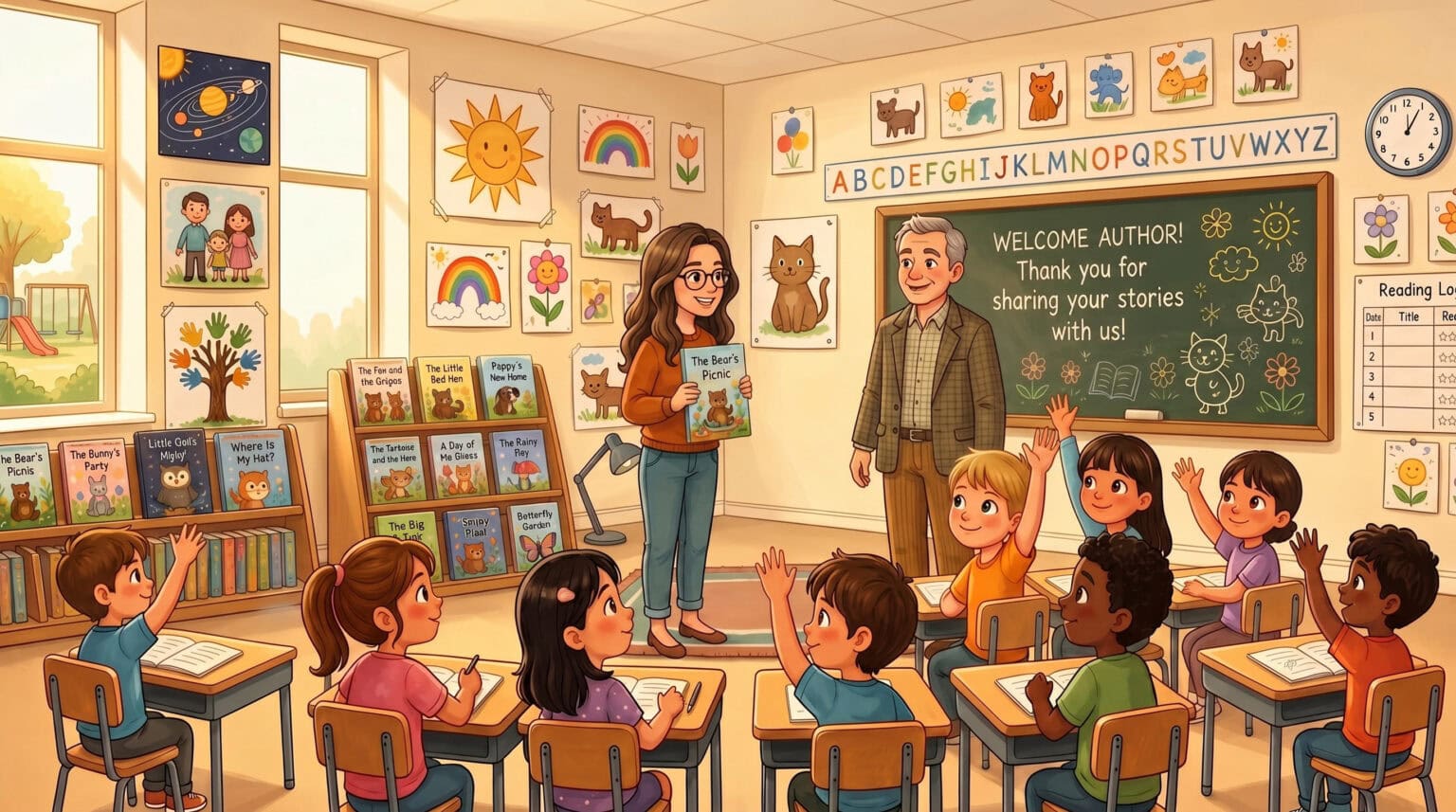
Schools and libraries represent massive market potential for children’s books but require a different approach than consumer sales. Virtual school visits charge $100-300 per 30-45 minute session and are a scalable revenue stream once established. In-person visits run $500-1,500 per day plus expenses. Start by offering a free first virtual visit to your local school to build testimonials and referrals. Create a professional one-sheet with your visit details, book information, author bio, and contact information. For library outreach, submit your book to review publications like School Library Journal. Reach out to librarians on social media (#librariansofinsta). Distribution through Baker and Taylor or Ingram puts your book in their catalog that libraries order from. If your book aligns with curriculum standards for social-emotional learning, literacy, or STEM, highlight this specifically in all library and school outreach. Authors who want to add educational content to their book before approaching schools should read about educational pages and activity integration.Building a Series Multiplies Your Marketing
Research shows series books sell 5-10x better than standalone titles over time. Each new book promotes the entire backlist. Parents who loved Book 1 eagerly buy Books 2-3-4. The Amazon algorithm recommends earlier books to buyers of later ones. Ideally, write two books before launching Book 1, then release Book 2 within 6-12 months. Launch Book 2 with a sale on Book 1. This “series sale” drives backlist velocity, which in turn boosts your overall BSR and algorithm visibility. Another long-term multiplier is turning your book into an interactive app. See the book to app conversion guide for how that process works.Sustainable Monthly Marketing Minimum
After your 90-day launch campaign, shift to a sustainable evergreen routine that requires 2-4 hours per month. Send a weekly email (30-45 min/week). Post 2-3 times on your primary social platform (20 min/day). Run a monthly review request campaign to recent buyers (30 min/month). Optimize your Amazon ads quarterly (1 hour/quarter). This minimum generates 10-30 sales per month for well-reviewed, properly positioned books, essentially passive income from the system you built during launch.Key Takeaways: Children's Book Marketing in 2026
- Start marketing 60-90 days before publication. Books with pre-launch audience sell 3-5x more in month one than books marketed starting on launch day.
- Build your email list first. Authors with 300 engaged email subscribers consistently outsell authors with 3,000 social media followers and no list.
- Get 10-15 reviews before spending money on Amazon ads. Reviews are the gatekeeper for ad conversion. Running ads with fewer than 10 reviews wastes budget.
- Amazon accounts for 65-75% of children’s book sales. Optimize your product page (title, description, categories, keywords, A+ content) before doing anything else.
- Focus on 2-3 marketing channels and execute them well. Spreading across 5+ channels produces mediocre results on all of them.
- A book launch is a 90-day campaign, not a 7-day event. Most authors quit at months 3-4, right before momentum kicks in.
- Series beats standalone every time. Each new book you publish makes all previous books more valuable and easier to sell.
- Marketing is a 6-12 month commitment before you see meaningful results. Authors who succeed treat the first book as a learning investment, not a get-rich-quick scheme.
Frequently Asked Questions: Children's Book Marketing
How much should I budget for marketing my first children's book?
Realistic marketing budgets vary by goal. A minimum viable launch costs $200-500 and covers ARC copies, a basic email service, and minimal Amazon ads. A moderate launch runs $500-1,500 and adds NetGalley or BookSirens, sustained email service, and $300-500 in Amazon ads. An aggressive launch costs $2,000-5,000+ and includes multiple ad channels, BookBub, and possibly a virtual assistant. Research shows authors who invest $500-1,000 in strategic children’s book marketing sell 3-5x more copies in year one than those who skip marketing entirely.
When should I start marketing before or after my book is published?
Start 60-90 days before publication. Books launched with pre-built anticipation (email list, ARC reviews, social media following) sell 2-4x more copies in their first month than books marketed starting on publication day. Use the pre-launch period to build your email list to 50-100 subscribers, send ARCs to 20-50 reviewers, and optimize your Amazon product page so you launch with reviews already posted.
Do I really need an email list if I have social media followers?
Yes, absolutely. Email converts to sales at 5-10x the rate of social media posts. Social media algorithms show your posts to only 2-5% of followers. Email open rates average 30-40%, meaning far more of your audience actually sees the message. You also own your email list entirely. Platform algorithm changes cannot reduce your reach. Authors with 300 engaged email subscribers consistently sell more books than authors with 3,000 social media followers and no list.
How many copies should I realistically expect to sell in year one?
With no marketing, expect 10-50 copies from family, friends, and organic discovery. With basic marketing ($0-500 budget and consistent effort), expect 200-500 copies. With strategic marketing ($500-1,500 budget and a proper 90-day campaign), expect 500-1,500 copies. With aggressive marketing ($2,000+ budget and professional support), expect 1,500-5,000 copies. These numbers depend on book quality, cover design, illustration quality, and niche appeal.
Should I enroll in KDP Select or go wide with distribution?
For first-time authors, KDP Select is recommended. It gives you access to Amazon ads (the most effective paid channel), Kindle Unlimited income, free promotion days, and Countdown Deals for promotional pricing. Since 65-75% of children’s book sales happen on Amazon, focusing there first makes strategic sense. After 90 days, evaluate results and decide whether to renew KDP Select or expand to Apple Books, Kobo, Barnes and Noble, and Google Play.</p>
For the technical side of setting up your Amazon listing correctly, see the <a href=”/childrens-book-dimensions-by-age-group/”>children’s book dimensions guide</a>.
How many reviews do I need before starting Amazon ads?
Get a minimum of 10-15 reviews before investing in Amazon ads. Running ads with fewer than 5 reviews wastes budget because clicks arrive at a product page without sufficient social proof to convert. Focus the first 30-60 days on review generation through ARCs, BookSirens, and direct buyer requests, then start ads once you cross 10 reviews. Authors with 15-20 reviews see 2-3x better ad conversion rates than those with 5-10 reviews.
Which social media platform should I focus on for children's books?
Instagram is the strongest single platform for children’s book authors because it is highly visual, the parent demographic (moms 25-40) is active, and Reels drive strong discovery for new accounts. Start with Instagram, grow to 500-1,000 followers, then add a second platform based on your goals. Pinterest works well for long-term website traffic. Facebook groups give direct access to parenting communities. YouTube builds long-term authority through read-alouds.
How do I get my first reviews when no one knows my book?
Use a three-phase approach. Phase 1: Send free copies to 20-30 friends and family with young children in your target age range. Expect 40-60% to post honest reviews by launch day. Phase 2: Reach out to parent bloggers and Instagram reviewers (search #kidlitreviewer) with a personalized message and free PDF. Expect 20-40% to follow through. Phase 3: Use BookSirens or BookSprout ($20-50) to access an audience of committed reviewers. Combine all three phases starting 6-8 weeks before launch.
Should I use Facebook ads or Amazon ads for my children's book?
Amazon ads are more effective for direct book sales. The average cost per click runs $0.15-$0.45 with conversion rates of 8-15%, because Amazon shoppers are already in buying mode. Facebook and Instagram ads run $0.50-$2.00 per click with 1-3% conversion for book sales, but they work well for building email lists through lead magnet promotions. The recommended approach: start Amazon ads for sales, then add Facebook ads later for audience building once your Amazon campaigns are profitable.
What do I do about negative reviews?
Usually, do nothing. Books with a mix of 4-5 star reviews sell better than all 5-star books because they appear more authentic. Negative reviews provide credibility, and most buyers ignore 1-2 outlier reviews. Authors who argue with reviewers damage their reputation. If you must respond, keep it professional, brief, and gracious. Never defensive or emotional. The better investment is getting more positive reviews to dilute the negative ones, not defending against them.
Your Realistic Children's Book Marketing Roadmap
Children’s book marketing is not rocket science, but it is strategic and it takes time. The 3-phase framework gives you the clearest path to sustainable results.
Phase 1 (60-90 days before launch): Set up your website and email service. Create a lead magnet and grow your list to 50-100 subscribers. Send 20-50 ARCs and secure 10-15 reviews for launch day. Optimize your Amazon product page completely before you publish.
Phase 2 (90-day launch campaign): Execute your launch week email sequence (5-7 emails). Post daily on social media and engage every comment. Activate Amazon ads once you have 10+ reviews. Track your BSR and sales data daily. Optimize ads weekly based on actual data.
Phase 3 (Month 4 and beyond): Shift to sustainable systems. Weekly email, 2-3 social posts per week, quarterly ad optimization. Begin school and library outreach. Start writing Book 2 while marketing Book 1.
The authors who succeed are not the ones with the biggest budgets. They are the ones executing fundamentals consistently over 12 months. Your book deserves to reach the families who need it. Start with Phase 1 today.
One More Thing Before You Start Marketing
Professional illustration is the foundation marketing cannot replace. A book with mediocre art is much harder to market than a book that stops parents mid-scroll. I offer a free custom spread so you can see exactly what Modern Disney-Style Digital Illustration looks like for your characters and story, before any commitment.
See the full illustration package details or jump straight to getting your free sample.
About the Author
Aris is a children’s book illustrator and educational content creator based in Athens, Greece. With 27 years of experience and 58+ published books, he has received the Disney Creativity Award in 2002 and was selected for Microsoft AppCampus funding in 2014.
ReadnLearn operates on a dual mission: providing professional illustration and publishing services to international authors while using that revenue to fund the development of free educational tools and therapeutic resources for children with autism and other learning differences. To request a free custom spread illustration or ask about available services, visit the services page or submit a request directly.
Additional reading: How to Self-Publish a Children’s Book | Activity Books for Kids: Complete Guide | Book to App Conversion Services
