
How to Choose a Children's Book Illustrator Without Regret (and Why Marketplaces Make It So Hard)
Decision paralysis when you choose a children’s book illustrator is not your fault. It is built into the marketplace model. The way out is proof: a free custom spread from your own manuscript, before you pay anything.

You are not struggling to find an illustrator. You are drowning in them. Thirty browser tabs, four shortlists, a spreadsheet, and no decision, sometimes for months. This page explains why that happens to smart, decisive people, what the research actually says about it, and the one thing that reliably ends it: seeing your own story illustrated before you spend a cent.
Authors ask me why I offer this. It’s to take away their anxiety.
The “this” is a free custom spread. Before any money changes hands, I illustrate one full spread from your actual manuscript, in the style we agree on, with expert paging advice for the whole book. You see your own story illustrated by the person who would illustrate the rest of the book. Then you decide. People assume it’s a marketing trick, a free sample the way a supermarket hands out cheese cubes. It isn’t. It exists because of something I watched happen to author after author who came to me: they were not struggling to find a children’s book illustrator. They were drowning in illustrators. Thirty browser tabs, four shortlists, a spreadsheet, and no decision. Some had been “choosing” for months. I want to explain why that happens, because it is not a personal failing and it is not bad luck. It is built into the way illustrator marketplaces work. Not any one platform. The model itself. Every project I take on also funds educational tools for neurodivergent children, and that matters to how I work, so I will get to the mission near the end.Why Can't I Decide on an Illustrator? The Science of Too Many Choices
Quick Answer: Research shows choice overload is real, but only under four conditions: complex options that are hard to compare, an effortful decision, uncertain personal preferences, and a desire to just get it done. Choosing a children’s book illustrator on a marketplace sits inside all four at once. That is why capable, decisive people freeze on this specific decision.
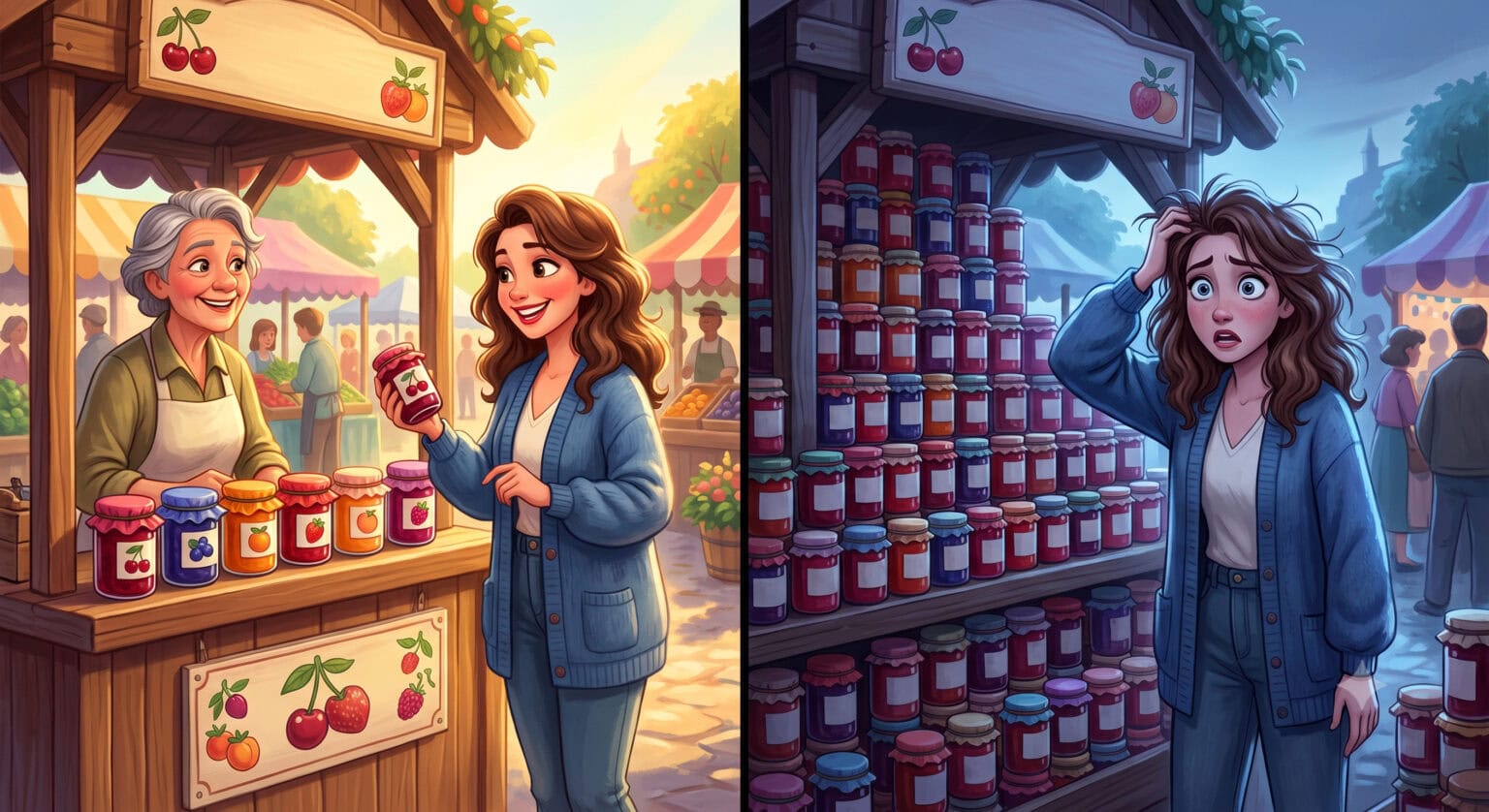
You may have heard of the famous jam study. In 2000, researchers Sheena Iyengar and Mark Lepper set up a tasting booth in a grocery store. With six jams on display, about 30 percent of tasters bought one. With twenty-four jams, about 3 percent did. More choice, dramatically fewer decisions.
Here is what the popular version leaves out: the effect is contested. A 2010 meta-analysis of 50 studies in the Journal of Consumer Research found the average choice-overload effect across the whole literature is close to zero. Sometimes more choice paralyzed people. Sometimes it did not. Sometimes it helped.
Then a more careful 2015 meta-analysis by Chernev, Böckenholt and Goodman found the pattern hiding in the noise. Choice overload reliably appears when four conditions show up together. The options are complex and hard to compare. The decision takes real effort. You are not sure what you actually prefer. And your goal is to get the decision over with, not to optimize forever.
Now picture a first-time author trying to choose a children’s book illustrator on a marketplace. Hundreds of portfolios, every one a different style, price structure and process, with no clean way to compare them. The biggest single investment in your book. Most first-time authors have never had to articulate the difference between painterly and vector until they are forced to. And you wrote a book to publish a book, not to spend three months auditioning strangers.
This decision does not merely resemble the conditions where choice overload appears. It sits inside all four at once. That is rarer than it sounds, and it is why authors who are decisive everywhere else in life get stuck exactly here.
Why Isn't the Marketplace Model Built for Picture Books?
Quick Answer: A picture book is one continuous project: 24 to 32 pages, one style, characters that must stay consistent across months of work. Fiverr, Upwork and Reedsy are built around discrete transactions: individual Gigs, contracts and quotes, each with its own fees and revision terms. Per their own documentation, none of them structurally guarantees the same illustrator stays with your book, or your series.
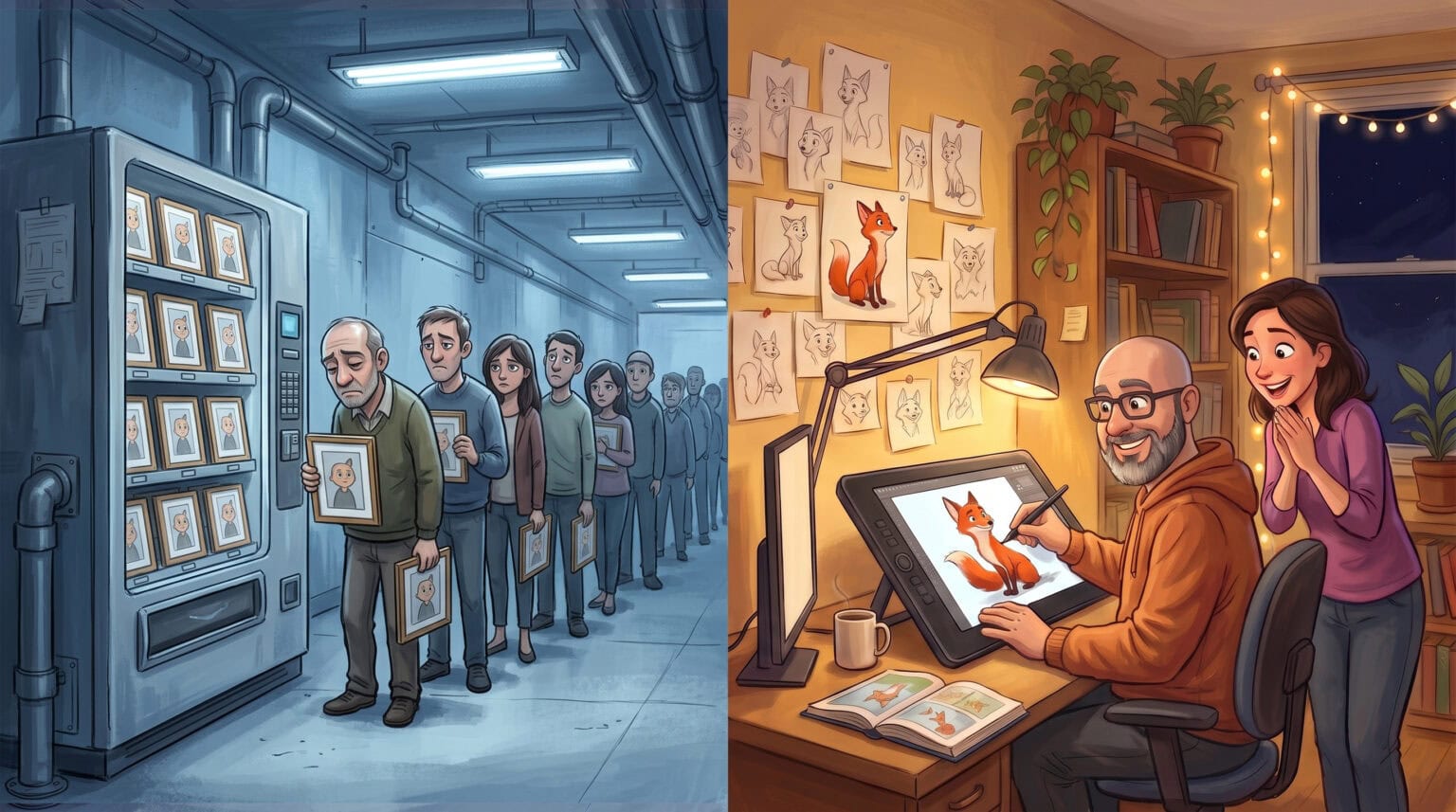
The psychology is only half of it. The other half is structural, and you can verify every piece of it in the platforms’ own documentation.
A children’s picture book is one continuous creative project. Twenty-four to thirty-two pages, one visual style, characters who must look like themselves on every spread, decisions on page one that ripple to page thirty-two. It usually takes months. What it needs, structurally, is one children’s book illustrator who stays.
Now look at what the marketplaces are actually built to sell.
How does Fiverr structure illustration work?
On Fiverr, the unit of work is the Gig: a discrete, individually priced order. Revision counts are set by each seller per Gig, not by the platform and not per book. Sellers pay Fiverr a flat 20 percent of every payout, and buyers pay a service fee on top of every order. Fiverr’s ranking rewards recent order completion and review velocity, which points sellers toward volume of small, fast orders. None of this is a scandal. It is a machine built for transactions, and a picture book is not a transaction.
How does Upwork structure illustration work?
On Upwork, freelancers pay a variable service fee of up to 15 percent per contract and compete for each job posting through a ranking system that includes a paid “Boost” auction, where freelancers bid for the top slots on your post. Revisions are scoped per milestone, each with its own review window. The entire mechanism is optimized for winning and completing individual postings. Nothing in it reserves your illustrator for the next milestone or the next book.
Is Reedsy different from Fiverr and Upwork?
Reedsy deserves to be treated differently, because it is different. Reedsy is curated: roughly 2.6 percent of professionals who apply are accepted, which pre-solves a real part of the choice problem that open marketplaces leave entirely to you. Its fees even reward continuity, tiering down when you keep working with the same professional.
But read Reedsy’s own author guidance and you find the same underlying shape: revision counts and scope are negotiated individually, quote by quote. Continuity is something you must negotiate for. It is never something the structure guarantees.
The marketplace model vs a dedicated illustrator: what actually differs?
Structural question | Marketplace model | Dedicated illustrator (ReadnLearn) |
|---|---|---|
Unit of work | Discrete Gig, contract or quote | The whole book, as one project |
Who you evaluate | Hundreds of unfamiliar portfolios | One person, proven on your own manuscript first |
Proof before payment | Not part of the model | Free custom spread from YOUR story |
Continuity to the next book | Negotiated per transaction, never guaranteed | The relationship is the product |
Interest in your book’s success | Ends when the order completes | Continues into publishing, marketing and launch |
Three platforms, three fee systems, one common design: the engagement ends when the order ends. Your book does not work that way, and your writing career definitely does not.
When Do Marketplaces Actually Make Sense?
Quick Answer: TMarketplaces serve budget-constrained, DIY-comfortable authors who can manage vetting, briefs and file specs themselves. Reedsy’s curation adds real value. And most visible complaints online are about scams, which vetting checklists help with. The critique here is about fit: for a first-time, risk-averse author who wants a guided relationship, the model works against you.
I am an illustrator with a service to offer, so you should be skeptical of me here, and I want to earn my way past that skepticism by conceding what is true.
Marketplaces solve a real problem for a real buyer. If your budget is a few hundred dollars and you are comfortable managing the vetting, the brief, the revisions and the file specs yourself, Fiverr and Upwork give you access to working artists at prices no professional studio can match. My own packages are $1,400 for a chapter book and $2,700 for a full picture book, and that is a different tier of investment for a different kind of author. Nothing in this article says otherwise.
Reedsy’s curation is real value, as I said above. Lumping it in with open marketplaces would be inaccurate, so I won’t.
And if you spend time in self-publishing groups, you will notice most of the loud complaints about hiring illustrators online are about scams and AI fraud, not about the model. That is a fair observation, and vetting checklists do help with it. But notice what checklists cannot do: a checklist can help you avoid a bad actor. It does nothing about per-order revision caps, or the fact that the illustrator of your book one has no structural reason to be available for your book two. You can vet your way out of a scam. You cannot vet your way out of the model.
Finally, marketplaces at this scale plainly produce successful hires every day. I am not claiming they fail everyone. I am claiming that for one kind of author and one kind of project, the deck is stacked in a way nobody tells you about, and that there is a different way to decide.
What Does Choosing Differently Look Like? Elisa's Story
Elisa Tsogidou is the author of Cat Coop and The Witch’s Hats. She did not find me on a platform. Her brother was searching online for a children’s book illustrator, landed on my work, and told her: that is your illustrator. She contacted me directly, one person writing to another person.
We started the way I start with everyone: with the free custom spread. She saw her own story illustrated before she committed to anything. From that one piece of free work came Cat Coop. Then The Witch’s Hats. Her third book is underway, and a fourth is planned. Her books are published in Greek, through Greek publishers, and the same collaboration has carried through every one of them.
And here is where it stopped being illustration. We are now bringing her work to the English-speaking market, starting with A.I. Santa as her first English release, and I am handling the whole journey: publishing the book on Amazon and IngramSpark, the marketing, and a promotional video for the launch. If it succeeds, the rest of her catalog follows, and so will the books she has not written yet. One free spread became a series, and the series became a publishing partnership.
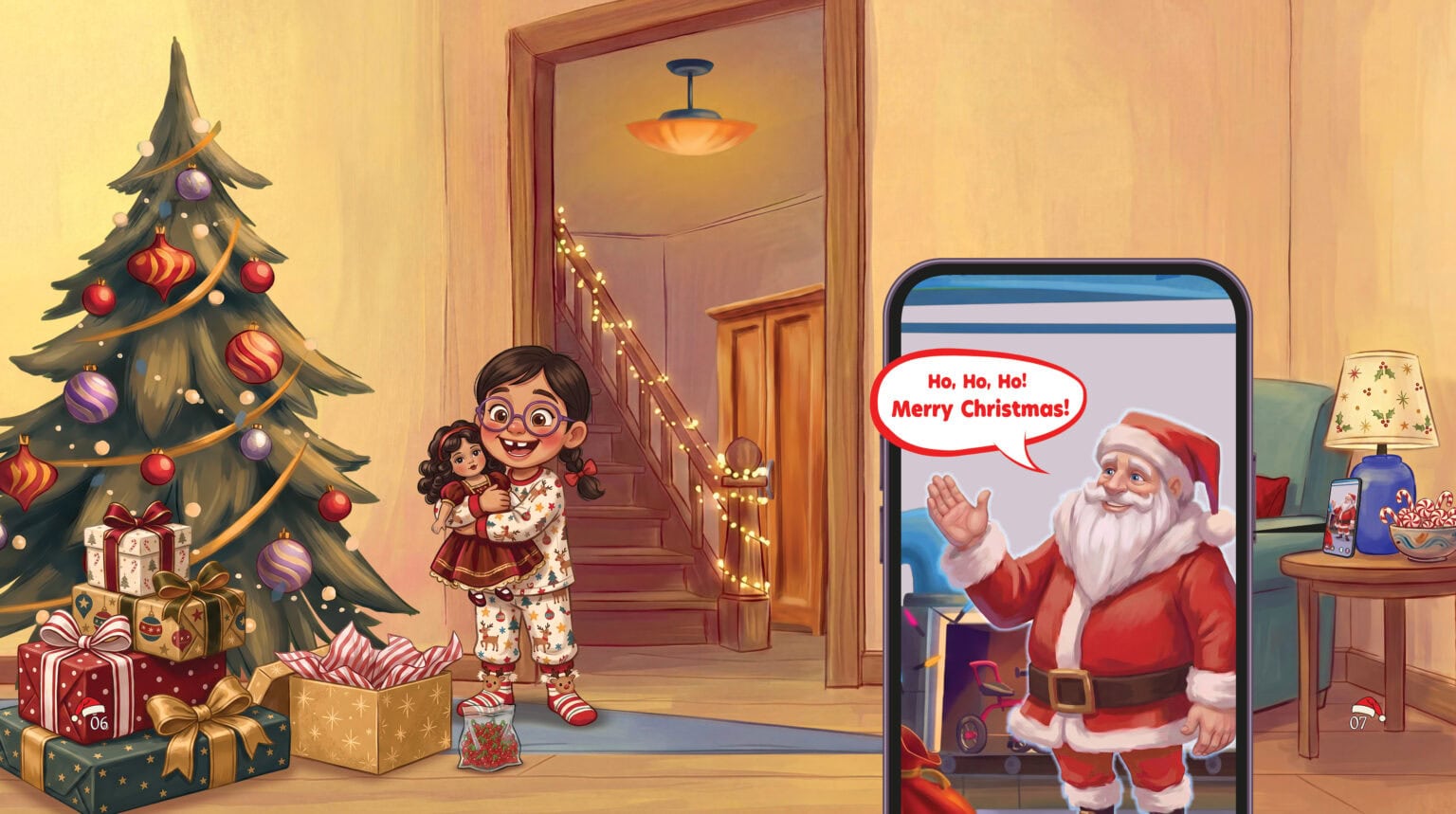
This is what she says about working together, published on this site:

Want to See Your Story the Way Elisa Did?
Get a free custom spread from your own manuscript to see if we’re the right fit. No credit card, no obligation.
Where Do Most Self-Published Authors Actually Stop?
Here is the pattern I have watched for years, and it is the part of this story nobody on the platforms will tell you. Most self-published authors make one book. Maybe a second. Then they quit. Not because they ran out of stories, but because the first book did not sell.
The two most common reasons a children’s book does not sell are the two things first-time authors economize on: the illustration and the marketing. A poorly illustrated book handled by amateur marketing is where most author careers quietly end.
On Amazon and IngramSpark you are competing against hundreds of new children’s books every week. You cannot go cheap on the product and expect to win there. And the uncomfortable structural truth is that the gig platforms have no stake in this at all: their revenue was earned the moment your order completed. Whether your book sells five copies or five thousand never appears on any marketplace dashboard. The model is pointed at the next gig, not at your launch. That is not a moral failing of any freelancer. It is simply where the model’s interest ends and where yours begins.
Elisa is the counterexample, and the lesson is bigger than one author: when the books succeed, authors keep writing. The series exists because the first book was good enough to deserve a second. That is the outcome I am structurally invested in, because my next project with an author only exists if their last book worked.
A Partner, Not a Pair of Hands
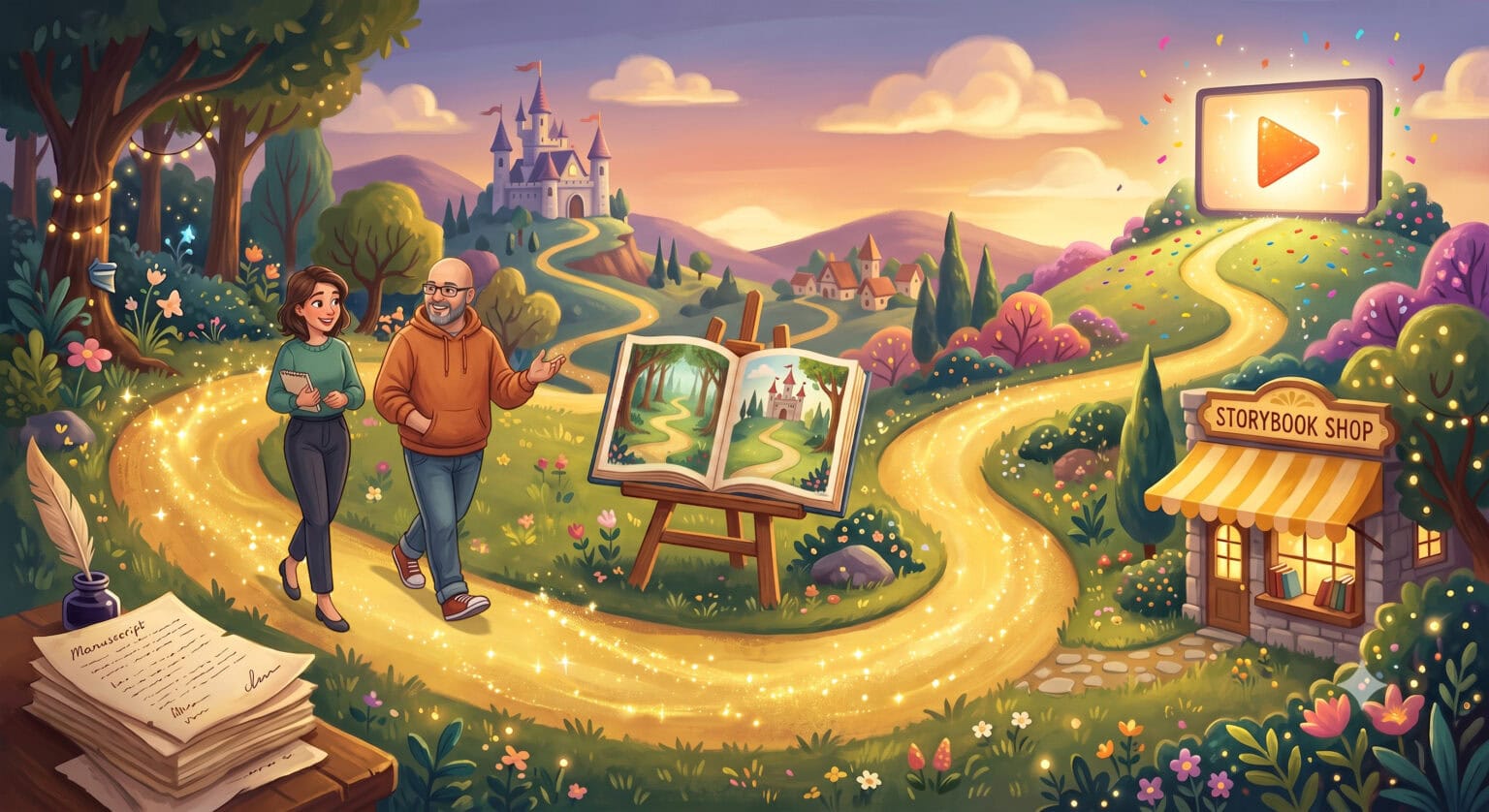
I’m not a faceless pool of illustrators to fish from. I’m one person, and from the first message you know exactly who you are talking to, who will illustrate your book, and who will still be here for the next one.
That changes what the engagement includes. Before a single illustration exists, you get expert paging advice: how your manuscript breaks across 32 pages, where the page turns should land, what a spread can carry.
During the work, you get one consistent style and characters who stay themselves, because one person is responsible for page one and page thirty-two, and for every decision in between.
And after the files are delivered, the part the marketplaces treat as the end, I treat as the middle: getting the book onto Amazon and IngramSpark with correct files the printer will not reject, and marketing it, including promotional video for your launch. If you want to see how I think about that side of the work, start with my guide to children’s book marketing. A dedicated book video marketing service is coming soon.
No platform offers this, and it is worth being precise about why. It is not that platforms are lazy. Their unit of work is the order, and everything I just described only exists across orders, in the space between books, which is exactly the space the model does not cover.
Why Do I Work This Way?
There is a part of this I rarely put in a sales argument, but it belongs here because it explains the whole model. My son Marios is nine, autistic and verbal with delayed speech. In 2026 he still sits with his speech therapist working from photocopies and flashcards, the same tools therapists used decades ago.
ReadnLearn exists to change that: every project I take on funds the development of proper educational books and apps for neurodivergent children, built by someone who lives this reality every day. Investing my time, energy and money in that is my choice, not my clients’ burden. Working with me simply means being part of it. You can read the full story on the mission page.
I mention it for a practical reason, not a sentimental one. A marketplace’s business model is the fee on your transaction. Mine is a long-term studio with a name, a face, a family history of designing for children going back to 1978 with board games, puzzles and educational content, and a reason to still be here, doing this work, when your fifth book is ready. That is the kind of counterparty you cannot select from a dropdown.
How Do You Choose an Illustrator Without Regret?
Quick Answer: Stop comparing portfolios in the abstract. Choice overload weakens when options become easy to evaluate and your own preference becomes clear, and nothing does both faster than seeing your own manuscript illustrated. A free custom spread from your actual story turns an anxious guess into an evidence-based decision, before any payment.
So here is my honest advice to the author with thirty tabs open, whether or not you ever work with me.
Stop trying to compare portfolios in the abstract. The research points at the way out: choice overload weakens when the options become easy to evaluate and your own preference becomes clear. Nothing does both faster than seeing your own manuscript illustrated. Not a stranger’s book in a portfolio. Yours.
That is the entire logic of the free custom spread. One spread from your actual story, in a style we choose together, plus paging advice for the whole book, before you pay anything. If it is not right, you have lost nothing and learned exactly what you prefer, which makes every other portfolio easier to judge. If it is right, the decision makes itself, the way it did for Elisa.
Authors ask me why I offer this. Now you know. It is to take away the anxiety, because the anxiety was never your fault. It was the model’s.
Key Takeaways: Choosing a Children's Book Illustrator
- Decision paralysis when you choose a children’s book illustrator is a documented psychological effect that appears under exactly the conditions marketplaces create, per a 2015 meta-analysis in the Journal of Consumer Psychology.
- Fiverr, Upwork and Reedsy are structurally built around discrete transactions; per their own documentation, none guarantees the same illustrator stays across a whole book, let alone a series.
- Marketplaces still make sense for budget-constrained, DIY-comfortable authors; this critique is about fit for first-time authors who want a guided relationship.
- Most self-published authors stop after one or two books, usually because of weak illustration and amateur marketing; the platforms’ interest ends when the order completes.
- Repeat multi-book relationships are the norm in a dedicated studio: Elisa Tsogidou went from one free spread to a book series and now an English-market launch with publishing, marketing and video handled.
- The fastest way to choose without regret is proof before payment: a free custom spread from your own manuscript, with paging advice included.
Frequently Asked Questions About Choosing a Children's Book Illustrator
How do I choose a children's book illustrator without regret?
Stop comparing hundreds of portfolios in the abstract and get proof instead. Ask an illustrator to show you your own story: one sample spread from your actual manuscript. It reveals style fit, communication quality and character consistency at once. I offer this as a free custom spread with paging advice, before any payment.
Why is it so hard to pick an illustrator on Fiverr or Upwork?
Research on choice overload shows paralysis appears when options are complex, the decision is effortful, your preferences are unclear and you want it done. Marketplace hiring creates all four conditions at once: hundreds of hard-to-compare portfolios for the biggest investment in your book. The difficulty is built into the model, not into you.
Is Reedsy better than Fiverr for children's book illustration?
Reedsy is meaningfully different: it accepts roughly 2.6 percent of applicants, so vetting is largely done for you, and its fees reward staying with one professional. But revisions and scope are still negotiated quote by quote, so continuity across a book or series is never structurally guaranteed. It reduces the choice problem without solving the transaction problem.
How can I see an illustrator's work on my own book before paying?
Request a sample from your actual manuscript. I illustrate one full custom spread from your story, in a style we agree on, with paging advice for the whole book, completely free. No credit card, no obligation. You decide with evidence instead of guessing from someone else’s portfolio.
How much does it cost to hire a professional children's book illustrator?
Professional children’s book illustration typically runs $2,500 to $5,000 for a full picture book, with established and award-winning illustrators charging $5,000 to $25,000+. My launch packages are $1,400 for a chapter book and $2,700 for a full picture book, with full commercial rights included. Full details are on the pricing page.
Why does having one illustrator matter for a whole picture book?
A picture book’s characters must look like themselves on every spread, and choices made on page one ripple to page thirty-two. When one person is responsible for the whole book, style and character consistency are the default. When work is split across separate marketplace orders, consistency depends on luck and negotiation.
What happens after my book is illustrated?
That is where most authors get stuck, and where I keep working: print-ready files, publishing on Amazon and IngramSpark, marketing, and promotional video for your launch. Most self-published authors stop after one poorly marketed book. The goal of a real partnership is a book that sells well enough to deserve a sequel.
Are illustrator marketplaces ever the right choice?
Yes. If your budget is limited and you are comfortable vetting portfolios, writing briefs and managing revisions and file specs yourself, marketplaces offer access to working artists at low prices. The tradeoff is that you carry the risk and the project management, and continuity beyond each order is never guaranteed.
Once your illustrations are commissioned, the next question is how to launch and sell the finished book. The children’s book marketing guide walks through every channel.
Ready to Choose With Proof Instead of Anxiety?
See What's Possible Before Committing
Send me your manuscript and get one full spread illustrated from your own story, plus expert paging advice for the whole book. Free, no credit card, no obligation. If it’s not right, you’ll still walk away knowing exactly what you want.
Already know what you need? View Packages & Pricing, Schedule a Consultation
Professional illustration is an investment that pays returns through higher sales, better reviews, and books that parents are proud to share with their children. At $2,700 $3,200 for complete 32-page illustration with full rights transfer (Save $500 with current launch pricing), my service offers exceptional value that positions your book for success in a competitive market.
About the Author
Aris is a children’s book illustrator and educational content creator based in Athens, Greece. With 27 years of experience and 58+ published books, he has received the Disney Creativity Award in 2002 and was selected for Microsoft AppCampus funding in 2014.
ReadnLearn operates on a dual mission: providing professional illustration and publishing services to international authors while using that revenue to fund the development of free educational tools and therapeutic resources for children with autism and other learning differences. To request a free custom spread illustration or ask about available services, visit the services page or submit a request directly.
