
Most first-time authors choose 8.5" x 11" because it feels like a real book. Then they discover bookstores won't stock it and printing costs run 40% higher than standard sizes. After 27 years illustrating children's books and working on 58+ published titles, I've watched countless authors make this exact mistake, often after already commissioning illustrations in the wrong format.
Here's what generic publishing guides don't tell you: children's book dimensions affect child development, printing economics, and whether your book fits on retail shelves. The wrong choice can add months to your timeline and thousands to your budget. Every decision you make before a single illustration is created will follow you through production, distribution, and retail.
In this guide, I'll walk you through exact dimensions for each age group, from board books for toddlers to middle grade novels. You'll learn what Amazon KDP actually supports (landscape orientations are not on the list), why 32 pages became the industry standard, and how to avoid the seven mistakes I see first-time authors make repeatedly.
Every illustration project I take on helps fund the development of autism-friendly educational apps and resources for neurodivergent children. Read about the mission.
Why Do Children's Book Dimensions Matter Beyond Aesthetics?
Quick Answer: Children's book dimensions affect three things most authors overlook: the physical ability of the target child to hold and use the book, the printing cost per unit on POD platforms, and whether retailers will stock it. Choosing the wrong format, or changing it after illustrations are commissioned, is one of the most expensive mistakes in children's book publishing.
When I consult with first-time authors, they often treat children's book dimensions as an afterthought, something to finalise after writing and illustration are complete. This almost always creates problems. The format drives every downstream decision: illustration composition, text placement, printing costs, platform eligibility, and retail shelf compatibility. Getting it right at the start is not just efficient, it's essential.
How Developmental Stage Drives Format Choice
According to developmental research cited by PrintNinja's Board Book Industry Standards, children's book dimensions must match the physical capabilities of the target age group. A toddler's hands can grip a 6" x 6" board book comfortably, but an 8.5" x 11" picture book becomes unwieldy and frustrating. Children ages 6-8 developing independent reading skills need books they can hold with one hand while turning pages with the other, making the 6" x 9" format ideal for early readers.
What Retailers Actually Require
Bookstore shelving is not arbitrary. Most picture book sections are built around specific standard sizes, and non-standard children's book dimensions may not fit shelf dividers properly. Barnes and Noble and independent bookstores prefer books that sit neatly alongside traditionally published titles. An 8.5" x 8.5" square slides perfectly into standard picture book displays. A custom 9" x 11" size can end up in the back room instead of on the shelf.
The Real Cost of Choosing the Wrong Size on KDP
Amazon KDP divides trim sizes into two cost tiers: "regular" (width 6.12" or less and height 9" or less) and "large" (anything exceeding those measurements). According to KDP's pricing documentation, the difference typically runs $1-2 per book in printing costs. On a $14.99 picture book, that extra $2 in printing can cut your margin by 25% or more, which directly affects your ability to price competitively against traditionally published titles.
What Are the Right Children's Book Dimensions for Board Books (Ages 0-2)?
Quick Answer: Board books for ages 0-2 use a 6" x 6" square format, with sizes ranging from 5" x 5" to 7" x 7". Page counts run from 8 to 24 pages with under 50 words total. The critical thing to know: neither Amazon KDP nor IngramSpark prints true board books. You need offset printing for the thick cardboard pages parents expect, which means minimum print runs and higher upfront costs.
If you're creating a book for infants and toddlers, you're in board book territory, and you need to understand a critical platform limitation before you commit to anything. This is one of the most common places first-time authors get a serious surprise late in the production process, usually after they've already begun design work.
Why the 6" x 6" Format Works for This Age Group
The 6" x 6" square format dominates the 0-2 children's book category, and the reasoning is straightforward. Small hands can actually grip and control the entire book. Parents can slip it into a diaper bag without a second thought. The smaller dimensions allow for the thick cardboard construction that survives teething, throwing, and the general destruction toddlers inflict on books. The square shape also provides equal visual weight, which supports early visual development in infants learning to focus.
The POD Reality Check for Board Books
Here's what most publishing guides fail to mention: Amazon KDP does not print true board books. Neither does IngramSpark. Board book printing requires specialized offset equipment to produce the thick, durable cardboard pages that define the format. If you want a genuine board book, you need a specialist like PrintNinja, which focuses on this format. Expect minimum order quantities of 500 or more copies and upfront costs well above what POD printing requires.
Your Three Practical Options as a Self-Publishing Author
When authors want board books for POD distribution, I give them three honest options. First, pursue offset printing with a specialist, but prepare for minimum order quantities and higher per-unit costs. Second, create a short hardback using KDP's hardcover option, knowing it won't have the thick pages parents expect. Third, start with a picture book format targeting ages 2-5 and expand your audience slightly to include older toddlers. Most first-time authors go with option three.
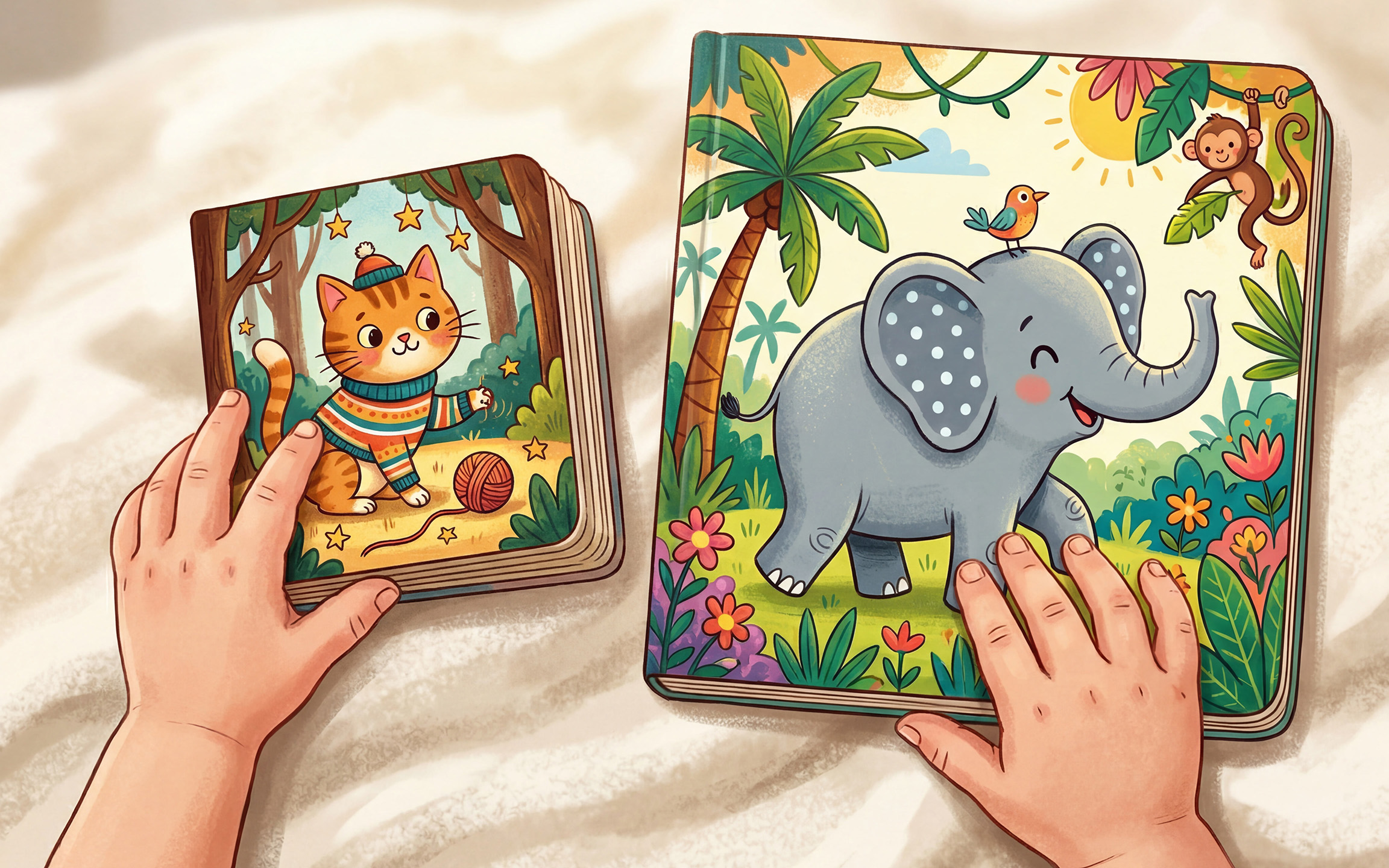
What Are the Best Children's Book Dimensions for Picture Books (Ages 3-5)?
Quick Answer: For self-published picture books targeting ages 3-5, 8.5" x 8.5" is the recommended default. It's the only square size available on both Amazon KDP and IngramSpark. Portrait formats (8" x 10") work on both platforms too. Landscape (10" x 8") is not available on KDP at all. The industry standard page count is 32 pages, which aligns with how commercial printers work and what parents and librarians expect.
This is where most self-publishing authors land, and where children's book dimension decisions become both more flexible and more consequential. The picture book category has the widest range of format options, the most platform constraints to navigate, and the highest stakes, since full-colour printing on large-format pages is significantly more expensive per unit than any other children's book format.
Why 8.5" x 8.5" Has Become the POD Standard
The 8.5" x 8.5" square format became the default for self-published picture books for one practical reason: it's the only square children's book size available on both Amazon KDP and IngramSpark. Many authors want distribution through both platforms, and using different dimensions for each creates production headaches. From an illustrator's perspective, the square format is genuinely versatile. It handles vertical compositions and horizontal ones without feeling cramped in either direction.
Why Are Picture Books Always 32 Pages?
The 32-page standard exists because of how commercial printers work. Publishers use a process called "signature printing" where large sheets are folded and cut into sections. Each signature contains 8 pages, making counts of 24, 32, 40, and 48 the most cost-efficient options. According to children's book writing expert Emma Walton Hamilton, the vast majority of picture books are 32 pages or 16 double-page spreads. One more thing to note: page 32 must be left blank on POD platforms for barcode placement, so you have 30 content pages to work with in practice.
Square vs Portrait vs Landscape: Which Should You Choose?
| Orientation | Best For | Amazon KDP | IngramSpark |
|---|---|---|---|
| Square (8.5" x 8.5") | Versatile stories, most subjects | Yes | Yes |
| Portrait (8" x 10") | Tall subjects: giraffes, buildings, trees | Yes | Yes |
| Landscape (10" x 8") | Journeys, panoramas, horizontal scenes | NOT AVAILABLE | Yes (11" x 8.5" only) |
This table has real consequences for authors. I've worked with clients who commissioned 32 full-colour landscape illustrations only to discover that KDP's entire trim size list contains zero landscape options. The fix always involves extra cost, extra time, or a compromise on the original vision. Confirm your platform before any illustration work begins. I cover the full platform comparison in the How to Self-Publish a Children's Book guide.
What Dimensions Work Best for Early Readers (Ages 6-8)?
Quick Answer: For ages 6-8, the recommended format is 6" x 9" with 48-80 pages and a word count of 500-2,000 words. This size works on both KDP and IngramSpark, fits in a child's single hand for independent reading, and has enough margin space for developing readers to track text comfortably. Font size at this age should be 12-14pt to support reading fluency.
The 6-8 age group marks the shift from read-aloud to independent reading, and children's book dimensions need to support that transition. Children at this stage are developing the fine motor skills needed to hold and turn pages on their own while building reading stamina. The picture-book-sized spread is too large to hold comfortably during solo reading. The 6" x 9" format fits in a child's single hand, slides easily into a school bag, and has the generous margins that developing readers need to track text without losing their place.
How the Role of Illustration Changes at This Age
Early readers still use illustrations on most pages, but their role shifts significantly. In picture books, illustrations carry about 70% of the storytelling. In early readers, that ratio flips to roughly 60% text and 40% illustration. Spot illustrations at chapter starts, scene breaks, and key moments maintain engagement without competing with the text. This format gives illustrators less real estate per page, but across 48-80 pages, the overall illustration volume remains substantial and the work requires just as much care.
What Are Standard Children's Book Dimensions for Chapter Books (Ages 9-12)?
Quick Answer: Chapter books and middle grade novels for ages 9-12 use 5.25" x 8" or 5.5" x 8.5" formats with page counts from 100 to 350 pages and word counts from 4,000 to 65,000 words depending on the sub-group. These fall into KDP's "regular" trim tier, meaning lower printing costs and better margins for the author. Illustrations at this age are typically limited to chapter openers.
By ages 9-12, children read for extended periods and expect their books to look like what their friends are reading. The compact 5.25" x 8" and 5.5" x 8.5" formats match traditionally published competitors on the shelf, fit easily in school bags, and fall into KDP's regular print tier. This means better margins compared to picture books. Font size typically drops to 11-13pt as reading fluency develops. For authors planning a series, the cost efficiency of these formats makes the investment significantly more sustainable over multiple titles.
Children's Book Dimensions by Age Group: Complete Reference Table
| Age Group | Book Type | Standard Dimensions | Page Count | Word Count | POD Notes |
|---|---|---|---|---|---|
| 0-2 | Board Book | 6" x 6" | 8-24 | Under 50 | Not available on KDP or IngramSpark |
| 3-5 | Picture Book | 8.5" x 8.5" or 8" x 10" | 32 | 200-500 | 8.5" x 8.5" works on both KDP and IngramSpark |
| 6-8 | Early Reader | 6" x 9" | 48-80 | 500-2,000 | Good POD compatibility on both platforms |
| 8-10 | Chapter Book | 5.25" x 8" | 80-120 | 4,000-15,000 | KDP regular tier (lower printing cost) |
| 9-12 | Middle Grade | 5.5" x 8.5" | 150-250 | 20,000-65,000 | KDP regular tier (lower printing cost) |
KDP vs IngramSpark: Which Platform Supports Which Children's Book Dimensions?
Quick Answer: Amazon KDP and IngramSpark both support square and portrait picture book formats, but they differ on landscape and hardcover. KDP has no landscape trim sizes. IngramSpark offers 11" x 8.5" landscape and can print short hardcovers with no page minimum. Neither platform prints true board books. If your distribution plan involves both platforms, 8.5" x 8.5" is the only square children's book size that works on both.
| Feature | Amazon KDP | IngramSpark |
|---|---|---|
| Square sizes | 8.5" x 8.5" only | 8" x 8", 8.5" x 8.5" |
| Landscape orientation | Not available | 11" x 8.5" only |
| Hardcover picture books | 75-page minimum (rules out 32-page books) | Yes, no minimum |
| Board books | No | No |
| A4 format (European) | Yes | Yes |
| Cost tier for 8.5" x 8.5" | Large tier (higher per-unit cost) | Standard rate |
One detail that catches authors off guard: KDP's hardcover option requires a 75-page minimum. A standard 32-page picture book doesn't qualify. If you want a hardcover picture book on KDP, you either need to expand your page count significantly or move to IngramSpark for hardcover production. This is a decision that needs to be made before illustration work starts, since it affects page layout, binding, and cover design.
Not Sure Which Format Is Right for Your Book?
Before I start any illustration work, I confirm every specification with you: trim size, page count, platform, bleed setup, and file format. If you want to see how your characters and story translate to a real illustrated page before committing to anything, the free custom spread is the best place to start.
Request Your Free Custom SpreadUS vs European vs International Formats: What Do International Authors Need to Know?
Quick Answer: American publishing uses imperial measurements. European publishing uses ISO paper sizes, with A4 (210mm x 297mm, approximately 8.27" x 11.69") as the standard. Both KDP and IngramSpark support A4. For most international authors targeting a global audience, US standard children's book dimensions (8.5" x 8.5" for picture books, 6" x 9" for early readers) are the safer default as they work globally without modification.
Working from Athens, Greece while serving authors in the US, UK, Australia, and across Europe has given me practical experience with cross-market format decisions. The two measurement systems are built around entirely different standards, but both major POD platforms accommodate both. The issue is more about what your local printing trade expects versus what online distribution platforms support globally.
My recommendation for international authors is to default to US standard children's book dimensions unless you're specifically targeting European bookstores where A4-based formats are the norm. An 8.5" x 8.5" picture book ships and sells through Amazon globally without any format adjustments. A European A4-based format may create complications in US distribution and retail contexts that are harder to reverse once production is underway.
How Do Children's Book Dimensions Affect Printing Costs?
Quick Answer: KDP divides trim sizes into "regular" (width 6.12" or less, height 9" or less) and "large" (any dimension exceeding those). Regular sizes print at lower cost. Large trim sizes, which include all standard picture book formats, cost $1-2 more per book. For a 32-page, full-colour picture book, expect printing costs of $3.50 to $5.00 per copy depending on the trim size you choose.
| Trim Size | Estimated Print Cost (32 pages, colour) | KDP Tier |
|---|---|---|
| 6" x 9" | ~$3.50 | Regular |
| 8" x 10" | ~$4.50 | Large |
| 8.5" x 8.5" | ~$4.75 | Large |
| 8.5" x 11" | ~$5.00 | Large |
The hardcover complication is worth spelling out here. KDP hardcover requires a minimum of 75 pages, which rules out standard 32-page picture books entirely. Authors wanting hardcover picture books on KDP need to either expand to 75+ pages or use IngramSpark, which has no page minimum for hardcover production. This is a distribution and pricing decision that affects everything from the retail price to where the book can be stocked, so it needs to be decided before any production work begins.
The 7 Children's Book Dimension Mistakes First-Time Authors Make
Quick Answer: The most costly mistake is choosing a landscape orientation and discovering KDP doesn't support it after illustrations are complete. The second is forgetting that page 32 must be blank for POD barcode placement. Most dimension mistakes share the same root cause: making format decisions after illustration work has started instead of before it.
After 27 years working with children's book authors, these are the format errors I see most frequently, roughly in order of how expensive they are to fix:
- Choosing landscape, then discovering KDP's limitations. Verify platform support before any illustration work begins. If landscape is non-negotiable, plan for IngramSpark-only distribution or offset printing from day one.
- Ignoring the 75-page minimum for KDP hardcovers. A standard 32-page picture book is not eligible for KDP hardcover. Know your platform requirements before finalising specifications.
- Picking a non-standard children's book size for differentiation. Standard sizes exist for proven reasons. Only deviate with a clear justification and a budget that can handle the added cost and distribution friction.
- Forgetting that page 32 must be blank. POD platforms require the last page for barcode placement. In a 32-page book, you have 30 content pages. Plan this from the start.
- Misunderstanding bleed requirements. Illustrations must extend 0.125" (3mm) beyond the trim line on all edges. Creating illustrations exactly to trim size results in white edges after cutting. Download the platform template before illustration work begins.
- Commissioning illustrations in the wrong orientation. Finalise your exact trim size before creative work starts. Provide your illustrator with the exact specifications and the platform's downloadable template file.
- Choosing dimensions that don't match the target age group. An 8.5" x 11" book for toddlers is too large for small hands and too awkward for lap reading. Match the format to the physical reality of your target reader.
Key Takeaways: Children's Book Dimensions
- The four main children's book dimension standards by age are 6" x 6" (ages 0-2), 8.5" x 8.5" (ages 3-5), 6" x 9" (ages 6-8), and 5.25" x 8" (ages 9-12).
- Amazon KDP does not support landscape orientations. If you want a horizontal picture book, plan for IngramSpark-only distribution or offset printing from the start.
- The 32-page standard for picture books is not arbitrary. It's driven by signature printing efficiency and by what librarians, retailers, and parents expect from the format.
- Neither KDP nor IngramSpark prints true board books. Board book production requires specialist offset printing with minimum order quantities of 500 or more copies.
- KDP hardcover requires a 75-page minimum, which rules out standard picture books. Use IngramSpark or offset printing for hardcover picture books.
- Always confirm your exact trim size before commissioning any illustrations, and give your illustrator the platform's template file, not just a measurement.
- For most international authors targeting a global audience, US standard sizes (8.5" x 8.5" for picture books, 6" x 9" for early readers) work on all major platforms without modification.
Frequently Asked Questions About Children's Book Dimensions
What is the most common size for a children's picture book?
The most common children's book dimensions for self-published picture books are 8.5" x 8.5" square. This format works on both Amazon KDP and IngramSpark, fits standard retail shelving, and gives illustrators good creative flexibility for both vertical and horizontal compositions. For traditionally published picture books, 8" x 10" portrait is also widely used, though this format is not available as a hardcover on KDP due to the 75-page minimum requirement.
Can I publish a landscape picture book on Amazon KDP?
No. Amazon KDP does not offer any landscape trim sizes. If your book requires a horizontal orientation, you have two options: use IngramSpark, which offers an 11" x 8.5" landscape size, or use offset printing through a specialist like PrintNinja. This is one of the most important things to confirm before commissioning any illustrations. Landscape scenes can sometimes be adapted to a square format, but that decision needs to happen before illustrations are created, not after.
Why are most picture books 32 pages long?
The 32-page standard comes from the economics of commercial printing. Printers fold large sheets into sections called "signatures," with each signature containing 8 pages. This makes page counts of 24, 32, 40, and 48 the most cost-efficient options because they align precisely with how the sheets are folded and cut. Going to 33 or 35 pages would require an extra full signature, adding cost and weight without purpose. It's a practical standard that became an industry norm over decades of commercial children's book publishing.
Can I print a board book through Amazon KDP or IngramSpark?
No. Neither Amazon KDP nor IngramSpark offers true board book printing. Board books require specialized offset equipment to produce the thick, durable cardboard pages that define the format. If you want a genuine board book, you need an offset printing service such as PrintNinja. Expect minimum order quantities of 500 or more copies and upfront costs well above POD rates. Some authors use KDP's short hardback option as an alternative, but these don't have the thick pages parents and toddlers expect.
What is the difference between regular and large trim sizes on KDP?
Amazon KDP charges different printing rates based on whether your trim size qualifies as "regular" or "large." Regular trim sizes have a width of 6.12" or less and a height of 9" or less. Large trim sizes exceed either of those measurements. Most picture book formats, including 8.5" x 8.5" and 8" x 10", fall into the large tier, which adds $1-2 per book in printing costs. This affects your royalty calculation and your ability to price competitively relative to traditionally published titles.
Should I use A4 or US letter size for a children's book?
For most children's book authors, US standard children's book dimensions are the safer choice even if you're based outside the US. US sizes work on both KDP and IngramSpark without modification and distribute globally without issues. A4 (210mm x 297mm, approximately 8.27" x 11.69") is supported by both platforms, but it's a less common format in children's publishing globally and can look slightly out of place in US retail contexts. If you're specifically targeting European bookstores, A4 is a reasonable choice. Otherwise, default to US standard sizes.
How many pages should an early reader or chapter book have?
Early readers for ages 6-8 typically run 48-80 pages with 500-2,000 words. Beginning chapter books for the same age group run 64-100 pages with 2,000-4,000 words. For ages 9-12, chapter books land between 80-120 pages (4,000-15,000 words) and middle grade novels run 150-350 pages (20,000-65,000 words). These ranges reflect the reading stamina and vocabulary development typical for each age group, not arbitrary conventions. A significantly shorter or longer book for a given age should have a clear reason behind it.
What bleed size should I tell my illustrator to use?
For both Amazon KDP and IngramSpark, illustrations should extend 0.125 inches (3mm) beyond the trim edge on all sides. This is called the bleed, and it ensures no white edges appear after the pages are cut during printing. The most reliable approach is to download the official template from your chosen platform and send it to your illustrator before any work begins. The template specifies the exact trim size, bleed area, and safe zones for text. Providing this upfront prevents one of the most common and frustrating production mistakes in self-publishing children's books.

