Educational Pages for Children's Books: Add Activities That Build a Readership
Adding story-anchored educational pages to your picture book does not raise its list price. It raises demand at the same price. For $1,200 I design the pages, build a download page that captures the parents who want them, and give your book a home on ReadnLearn.

Most authors come to me asking whether educational pages will let them charge more for their book. The answer is no, and the real answer is better. I went looking for evidence, comparing picture books carrying activity pages against closely matched books that do not, and the pattern held. Books with educational back matter did not list higher than their comparables. They sold to more people at the same price.
That changes what you are buying. Not three extra dollars a copy, but the reason a parent picks your book over the one beside it and comes back to say so in a review. This page covers what I make, what it costs, and what the numbers actually support.
Every illustration project I take on helps fund the development of autism-friendly educational apps and resources for neurodivergent children. Read about the mission.
What do educational pages actually do for a children's book?
Quick Answer: Educational back matter does not reliably raise a picture book’s list price. What it raises is demand at the same price. Across five matched pairs of Christmas and Advent picture books, the ones with activities sat at or below their story-only comparables on price, while four of the five carried noticeably more reviews. The clearest case was a lift-flap Advent book at 554 reviews against a same-priced book with 15.
I want to be precise about that evidence, because a lot of publishing advice rests on averages that control for nothing. These were matched pairs: same genre, same shelf, same format, one against one. Compare 32-page story books against 56-page activity books instead and the activity books look pricier, but they are also bigger. That measures paper, not back matter.
Hold the format steady and the price premium disappears, with something more useful in its place. Reviews drive the Amazon algorithm, the algorithm drives visibility, and visibility drives sales. A book earning reviews at a normal price is in better shape than one priced above its shelf.
There is a second effect, and it is the one I would build a plan around. Educational pages make your book fit what teachers, homeschool parents and activity-minded buyers are already looking for. Most self-published picture books are story only, so a parent searching for something their child can do after the story finds far fewer options than they expect.
Chapter books are a different case
If you write chapter books rather than picture books, the picture changes and I do not want to blur the two together.
For reading-comprehension chapter-book bundles, a real list-price premium does exist. Across five matched pairs, the hybrids listed roughly 20 to 50 percent above their story-only comparables and held it.
The caveat is as important as the finding. In every one of those pairs, the story-only book carried far more reviews, often ten to a hundred times more. So the chapter-book premium buys price and not demand, which is the exact mirror image of the picture-book finding above. Those are two different effects pointing in opposite directions, and neither one transfers onto the other format.
What do you get for $1,200?
Quick Answer: The educational add-on is $1,200 and attaches to a book illustration project. It covers eight pages of story-anchored educational material, a download page on ReadnLearn that delivers the extension pack to your readers, your own author page, and access to the parent and teacher list that grows from those download pages. It is an add-on, not a standalone package.
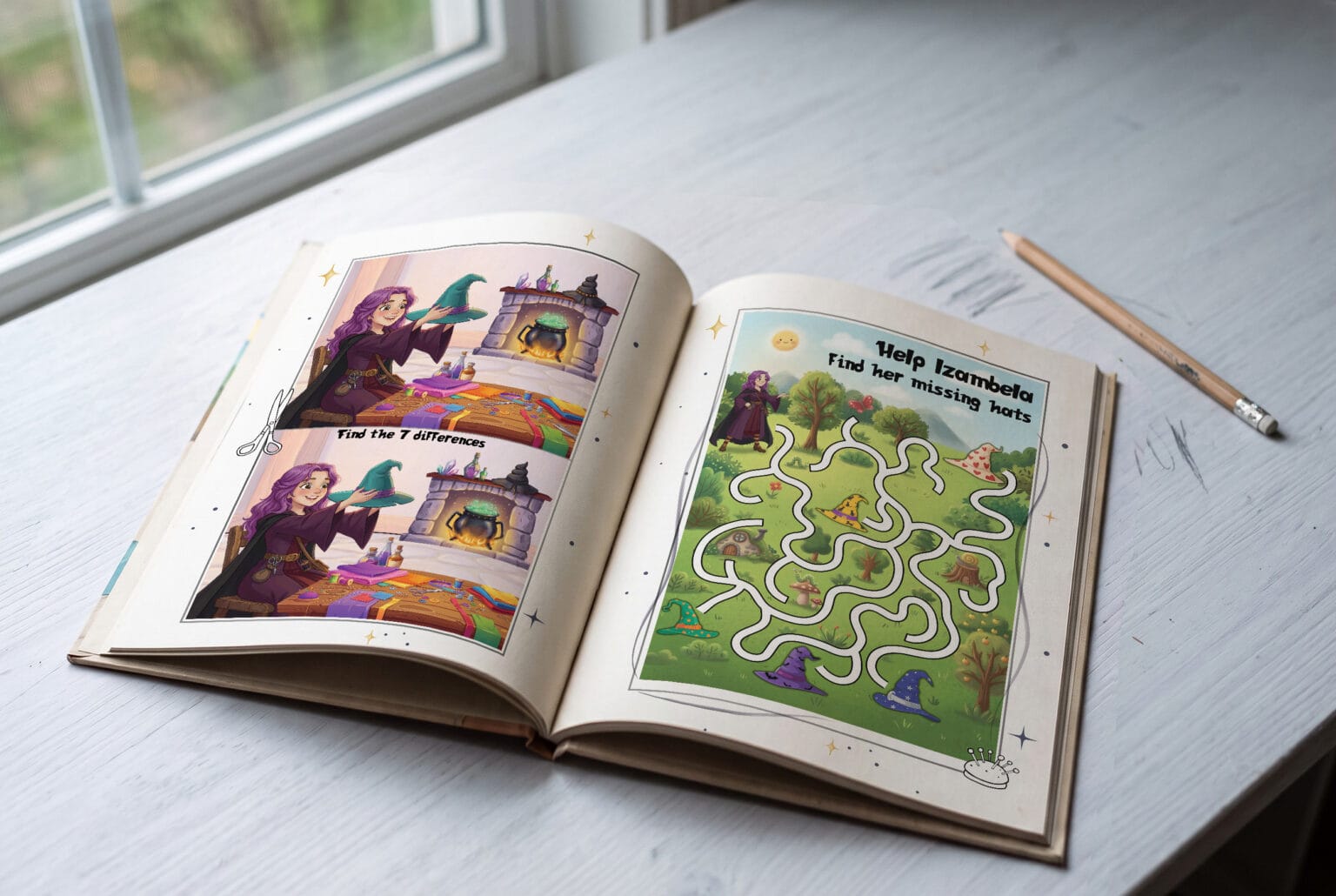
The eight pages are built from your story, not pulled from a template library. Your characters appear in the activities, your settings become the counting exercise, a craft ties to something that happens in your book. That is what makes the pages worth printing rather than worth skipping, and why I read your manuscript before specifying them.
| What the $1,200 add-on includes | Where it lives |
|---|---|
| Eight educational pages, built from your story | Split between your printed book and the download pack |
| A ReadnLearn download page your book’s QR code points to | Hosted and maintained by me |
| Your own author page: bio, books, buy links | On ReadnLearn, updated when you publish |
| Access to the pooled parent and teacher list | I email it on your behalf at launch |
| Two rounds of revisions | At the review stage |
| Print-ready final files | Delivered in week six |
Three of those I have not seen another illustrator offer, so let me explain what they do. A QR code in the back of your book sends a parent to a download page on ReadnLearn that delivers the rest of the pack, with your author page alongside it carrying your bio, your books and your buy links.
Readers who arrive that way can join a ReadnLearn list, and when you launch, I email that list on your behalf. I do not hand over raw data. Every signup is consented and every email carries an unsubscribe. The list is still growing, which is the real reason to be early: the authors who come in now stay in front of it longest. If you are planning a launch, the children’s book marketing guide covers how this fits the rest of the plan.
One detail in that flow is not a preference, and I build it the same way every time.
The download delivers first, and the signup sits below it
When a reader scans the QR code, the pack downloads. The email signup is offered underneath it, never in front of it.
That ordering protects your book. Amazon’s Hyperlink Guidelines permit links to ancillary material like printables, and prohibit links to web forms that request customer information. A download locked behind an email form is the prohibited pattern, and the guideline is explicit for the Kindle edition of your book.
It also converts better, which is a happy coincidence rather than the reason. People who already have the thing you promised are more willing to hear from you again.
What goes in your book, and what goes in the download?
Quick Answer: The package is eight educational pages. How many of them print inside your book is decided per book, not by a fixed rule. A 32-page story has room for up to eight printed pages before it reaches 40, which is the last page count inside KDP’s flat premium-color printing band. A longer story leaves less room, so more of the eight goes to the download pack.
Here is the constraint in plain numbers. On KDP, a color interior at regular trim costs $3.60 a copy to print at any length from 24 to 40 pages. Above 40 it becomes a dollar plus about six and a half cents per page, or eight on large trim. So the pages between your story’s end and page 40 are free, and the ones after are not. Going past 40 is a legitimate choice and I will price it with you rather than talk you out of it, but you should decide it knowing the number rather than discover it on your first royalty statement. The figures come from KDP’s published printing cost tables.
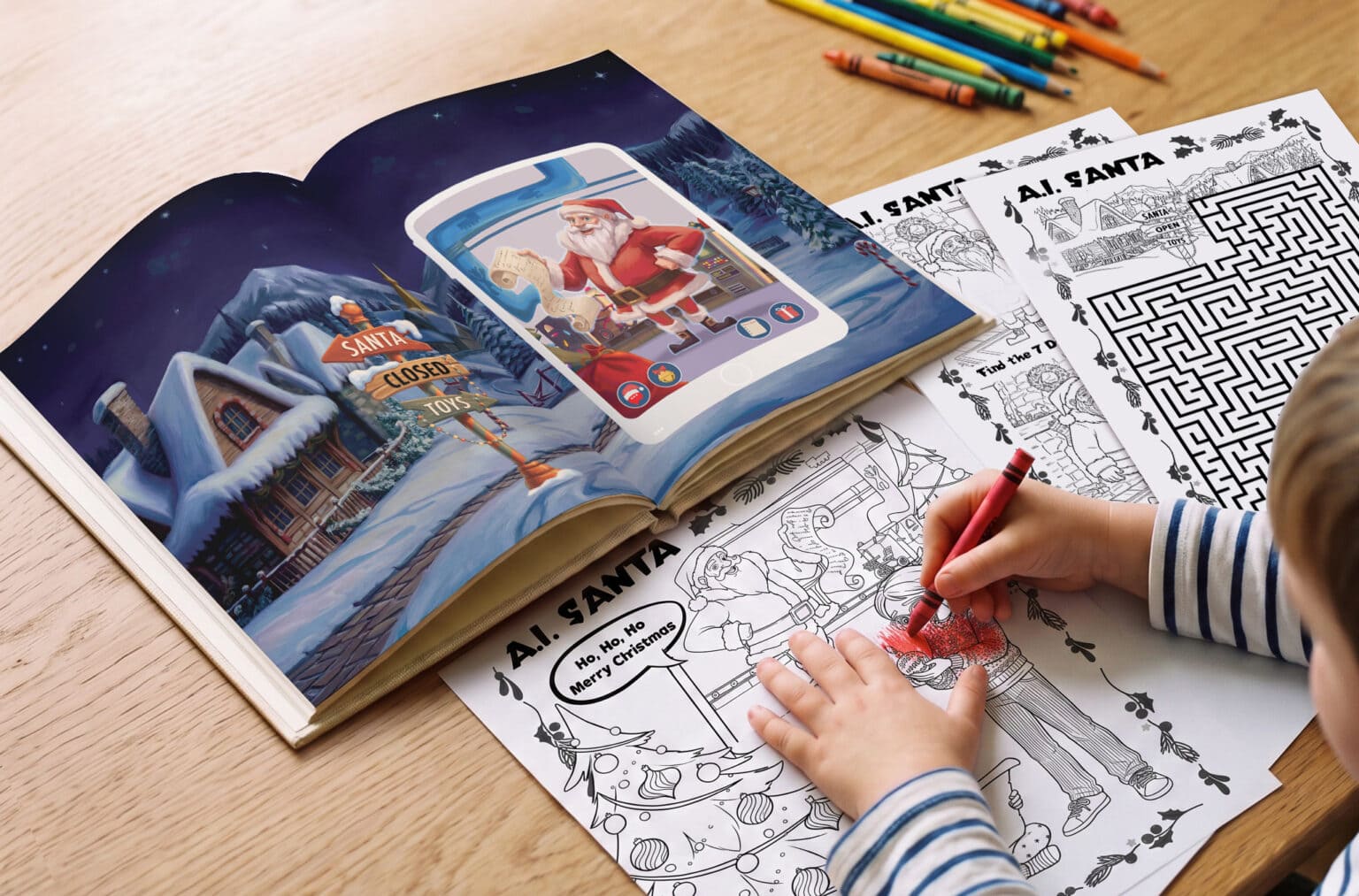
The printed pages live in the book. The rest arrive as a download, so a parent can print them as often as a child wants them.
The second constraint has nothing to do with cost. Back matter that overshadows the story makes a worse book, and the evidence is unkind: the two lowest-rated titles in the comparison set both leaned on generic discussion questions at premium prices. Padding gets punished by reviewers. So whatever the printing band allows, the printed set stays small enough that the story is still the hero, and the rest goes to the download where length costs nothing. Every question I write is paired with something to make or do, because a prompt on its own is the format that underperforms.
What the activities look like at each age
The activity types are drawn from what actually appears in successful educational books at each age band, not from what looks good on a services page.
- Ages 3-5: counting activities, alphabet recognition, matching games, spot-the-difference, connect-the-dots, coloring pages, sorting exercises, and simple mazes.
- Ages 6-8: reading comprehension questions, word searches, more complex mazes, color-by-number puzzles, drawing prompts, and writing exercises.
- Ages 9-12: deeper comprehension questions, creative writing extensions, character analysis, research projects, and journaling prompts.
One honest note on the youngest end. For children under six, I could find no good evidence that printed activity pages work at all, because at that age the thing that engages a child is the format itself: flaps, textures, things to touch. If your book is aimed at two and three year olds, I will tell you that printed activity pages are the wrong spend before I take the money.
How does the six-week process work?
Quick Answer: Six weeks from finished story to final files. Week one is reading your manuscript and specifying which activities fit it. Weeks two and three are designing the pages. Week four is illustration. Week five is your review and revisions. Week six is final files and KDP setup. You approve the specification before any page is designed.
Week 1, story review and activity strategy. I read your manuscript properly and come back with a page-by-page specification: which activity types suit your story, which print, which go to the download pack, and why. You approve it before I draw anything, because the cheapest time to change direction is before the work exists.
Weeks 2-3, activity page design. I build the pages from your story’s own material, your characters and settings and plot points, turning the specification into real layouts.
Week 4, illustration integration. Every activity page gets the same treatment as your story pages, characters consistent across both. A page that looks like it came from a different book undoes the effect.
Week 5, review and refinement. You see everything, and we do two rounds of revisions.
Week 6, final files and KDP setup. Print-ready files, correct trim and bleed, page count checked against the printing band, and the QR code placed and pointed at your live download page.
Not sure the style is right for your story?
Before you commit to anything, I will illustrate one spread from your actual manuscript so you can judge the work on your own material rather than on someone else’s book. No credit card, no obligation.
Does the $1,200 pay for itself?
Quick Answer: Moving a paperback from $8.99 to $11.99 is worth about $2.70 more per copy, because $11.99 clears KDP’s $9.99 threshold and earns the 60 percent royalty rate instead of 50 percent. At that gap, the $1,200 add-on is covered by 445 copies. How long 445 copies takes depends entirely on your book and your marketing, and I am not going to invent a number for that.
Here is the arithmetic, because you should be able to check it against KDP’s published royalty rates.
| Figure | Story only at $8.99 | With educational pages at $11.99 |
|---|---|---|
| KDP royalty rate | 50 percent (under the $9.99 threshold) | 60 percent (over the threshold) |
| Gross royalty | $4.495 | $7.194 |
| Less printing cost | $2.30 | $2.30 |
| You earn per copy | $2.20 | $4.89 |
Printing costs above are for a black-ink interior. A color interior costs more per copy, but it costs the same for both books, so the difference between them does not move. The gap comes entirely from the royalty rate, which is why it holds whatever your book costs to print.
Break-even is $1,200 divided by $2.70, which is 445 copies. I am deliberately not converting that into months. The published figures for what a self-published children’s book sells are averages across a population dominated by amateur illustration and weak covers, which is not a fair comparison for your book, and studying only the books that sold well tells you nothing, because those get called good precisely because they sold. You know your launch plan better than any average does.
One scenario worth knowing: a school or co-op buying 25 copies at list price through Amazon returns about $122 in royalties on the $11.99 edition. Negotiate a direct bulk sale instead and expect the buyer to want 40 to 60 percent off list, which is normal for that channel and changes the math.
A note on where the institutional route really stands. Educational pages make your book a better fit for teachers and homeschool buyers, and those are real buyers you can reach directly. Formal library and school acquisition is a different matter, running through distributors, trade discounts, catalog metadata and review journals. Those gates are what open it, not back matter. I would rather say so now than let you buy pages expecting a library contract.
See it on your own story first
Quick Answer: Before you commit to anything, I will illustrate one spread from your actual manuscript at no cost. Not a portfolio sample, not a generic character, your story. No watermarks and no strings. If you do not like it, you have lost nothing and I have learned something.
Most illustrators ask you to commit thousands of dollars on the strength of a portfolio full of other people’s books. That is backwards. A portfolio tells you what someone did for a different story, with a different tone and different characters.
So I do it the other way around. Send me your manuscript, I illustrate a spread from it properly finished, and you judge my work on your own material. If it is a fit, we talk about the rest. If not, we part on good terms. You can request your free custom spread now, or see how the illustration package this attaches to is priced first.
Key Takeaways
- Educational back matter does not reliably raise a picture book’s list price. It raises demand at the same price, clearest in a matched pair at 554 reviews against 15.
- Chapter books are the exception, with a real 20 to 50 percent list premium, though those hybrids carry fewer reviews than the story-only books they beat on price.
- The add-on is $1,200 and attaches to an illustration project: eight educational pages, a download page, your own author page, and access to a growing reader list.
- A 32-page story has room for up to eight printed pages before hitting 40, the last count inside KDP’s flat color printing band.
- Moving from $8.99 to $11.99 is worth $2.70 a copy, so $1,200 is covered by 445 copies.
- Your download page delivers first and asks for an email second, which keeps your book compliant with Amazon’s linking rules.
Common Questions About Educational Pages
Will the activities distract from my story?
Who actually buys books with learning activities?
Can I see examples?
<p>The hybrid format is uncommon, which is exactly why it is worth doing, and it does mean I cannot point you at a shelf full of them. What I can point you at is the evidence. Comparing activity picture books against closely matched story-only ones, the activity books did not cost more but consistently drew more readers, in the clearest case 554 reviews against 15 at the same price. You can see my <a href=”/projects/childrens-educational-book-design/”>educational book design work</a> directly, I will walk you through the exact activity types I would build for your story in a consultation, and you can have a free spread from your own manuscript before deciding anything.</p>
What if I already have my story illustrated?
I will look at your existing illustrations first and tell you straight whether I can match the style closely enough that the activity pages do not look bolted on. If it is a good fit, I will make one free sample activity page so you can see the match before committing. If it is not, I will say so.
How do my readers get the download, and what do I have to run?
You run nothing. The QR code in your book points at a page I build and host on ReadnLearn. The pack downloads immediately, and the email signup sits below it rather than in front of it, which is both better for conversion and required by Amazon’s rules about links in books.
What happens to my author page and the reader list?
The author page is yours for as long as it is useful, carrying your bio, your books and your buy links, and I update it when you publish something new. The reader list stays on ReadnLearn and I email it on your behalf when you launch. I do not hand over raw subscriber data, to you or anyone. Every signup is consented and every email carries an unsubscribe link.
Experience You Can Trust
27 years of experience creating educational content for children
58+ Published Children’s Books across multiple age ranges and educational topics
25+ Educational Apps including autism-friendly therapeutic apps and curriculum-aligned learning tools
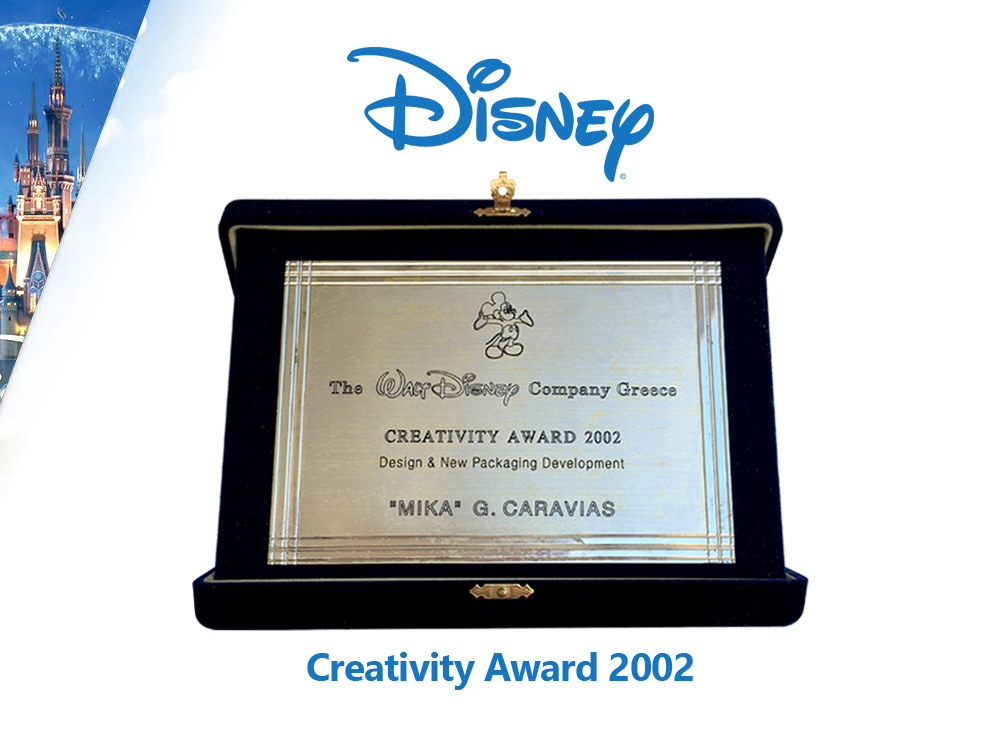
Industry Recognition from Disney (Creativity Award 2002) and Microsoft (AppCampus funding 2014)
Autism-Friendly Specialization for books addressing special needs themes or activities designed with neurodivergent learners in mind