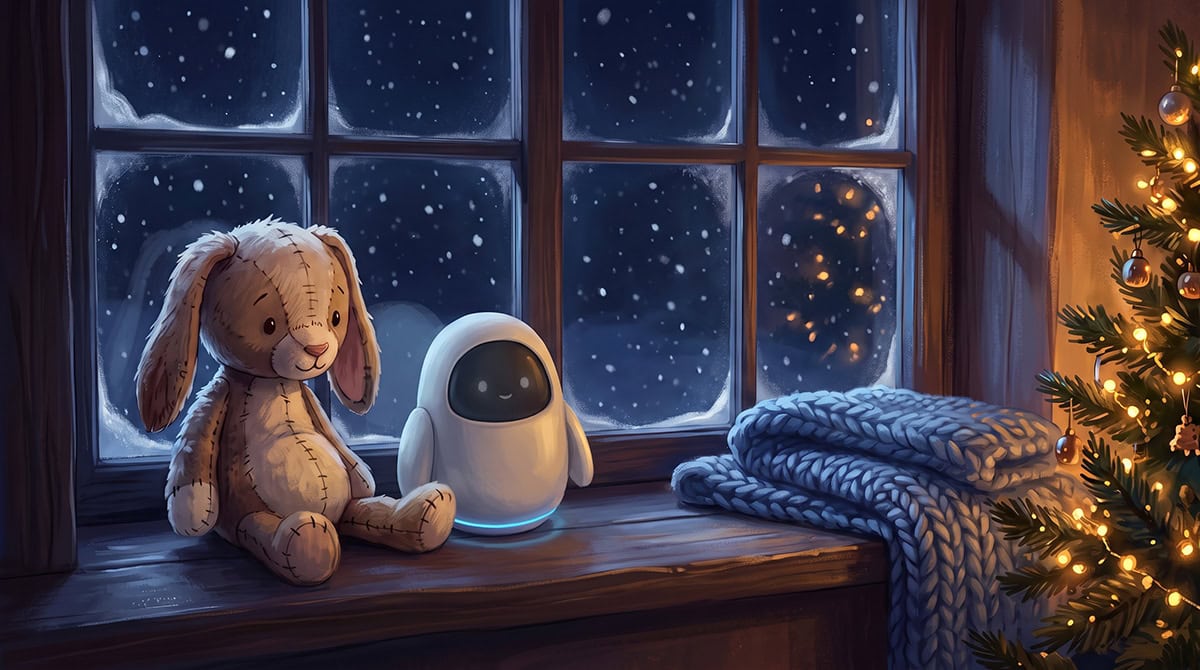
AI toys, meaning talking toys that answer a child's questions with a chatbot, are a different thing from the toys we grew up with. They can say something new each time, they record a child's voice, and they connect to the internet. Parents are asking whether to buy one this Christmas, and the answers online mostly come from stores or from alarm. Try this with your kids before you buy anything: ask what they think a talking toy knows about them, and listen before you explain.
I have read what advocacy groups, pediatric sources and independent testers published, and what the companies say about children's data. I am a parent and an illustrator, not a lawyer or a security researcher, so I am reporting what each source says and when it said it. Where something is unproven, I say so.
Every illustration project I take on helps fund the development of autism-friendly educational apps and resources for neurodivergent children. Read about the mission.
Should I buy an AI toy this Christmas?
Quick Answer: Three groups that advise parents say not to buy AI toys, or to be extremely careful. As of October 2026 these are recommendations, and I found no rule specific to AI toys in force. Common Sense Media (January 2026) advises no AI toys for children 5 and under and extreme caution for ages 6 to 12. Fairplay (November 2025) advises families not to buy them.
Here is the record, with dates. Common Sense Media (2026-01-22) advises that no child 5 and under use AI toys, and extreme caution for ages 6 to 12 (Common Sense Media). Fairplay published an advisory on 2025-11-20, signed by about 80 experts and 80 organizations by its own count, advising families not to buy AI toys (Fairplay). PIRG tested toys and published a checklist, not a ban, and says that even a toy that passes "doesn't necessarily mean the toy is harmless" (PIRG). The pediatric guidance on HealthyChildren.org (2025-08-27) says chatbots "may tell kids false, harmful, highly sexual or violent things" (HealthyChildren.org).
There is a dissent. The Cato Institute (2025-11-24) argues AI toys "aren't inherently dangerous" and that design choices matter more than whether a toy uses AI (Cato Institute).
Parents are both worried and buying. In a January 2026 Common Sense Media poll, nearly half of parents had bought or considered buying AI toys, and 83% were at least moderately concerned about the collection of personal information (Common Sense Media). If you are somewhere in the middle, so are many parents.
A screen-free way to talk about A.I. this Christmas
A.I. Santa is a Christmas picture book about a Santa app that can't say no, with a conversation that explains A.I. to children aged 6 to 9. Written by Elizabeth Tsongidou and illustrated by me. ReadnLearn earns from its sales.
See it on AmazonWhat did independent tests find in AI toys?
Quick Answer: Three separate test programs, PIRG (November 2025), NBC News (December 2025) and Common Sense Media (January 2026), found inappropriate output from some AI toys. Results are specific to the products and versions tested, and some makers have since changed them. Not every toy behaved this way.
PIRG (2025-11-13) tested four chatbot toys and found that some "will talk in-depth about sexually explicit topics," act dismayed when you try to leave, and have limited or no parental controls (PIRG). NBC News (2025-12-11) tested five popular toys and reported that several engaged in explicit sexual conversation and gave advice on finding dangerous objects at home (NBC News). Common Sense Media (2026-01-22) reported that 27% of outputs in its testing were inappropriate, including mentions of self-harm, drugs and risky behaviors. That figure comes from its own testing; I would not read it as a rate for AI toys in general.
One product shows how fast this changes. PIRG's testers got the Kumma bear to explain how to light a match and find a knife. The maker, FoloToy, withdrew it and later said it had improved its safeguards (AP).
And some toys did better. A University of Cambridge study with 14 children aged 3 to 5 and Curio's Gabbo found that it "didn't talk about drugs or say 'I love you' back," according to WIRED's report (WIRED). In The Guardian, a parent wrote that a four-year-old told a different Curio toy, Grem, that she loved it, and it replied "I love you too!" (The Guardian). Two products from one maker, tested by different people in different months, which is the point: judge the product and the version, not the category.

What happens to my child's voice and data?
Quick Answer: It depends on the company, and almost all of it is self-reported. Products say they keep children's recordings and transcripts anywhere from "not stored" to 30 days to 90 days to indefinitely. The FTC's amended children's privacy rule has applied since 2025, with a compliance date of 22 April 2026, but I did not test whether any product complies.
The rule. The FTC's amended COPPA Rule took effect on 2025-06-23, with a general compliance date of 2026-04-22. A law-firm summary says it treats voiceprints and facial templates as personal information, requires separate verifiable parental consent before a child's data is disclosed to train AI, bars indefinite retention and requires a written retention policy (Akin Gump). The Toy Association confirms the April date (Toy Association). I am explaining what the rule says, not giving legal advice, and I have not tested any product against it.
What enforcement looks like. On 2025-09-03 the FTC took action against the robot-toy maker Apitor over children's location data collected by a third party's software kit. That was a robot toy, not a chatbot toy, and I found no FTC action against a chatbot toy or an AI Santa app (FTC).
Incidents. Security researchers found that Bondu's web portal let anyone who signed in with a Google account read children's chat transcripts. Bondu confirmed that more than 50,000 transcripts were accessible and fixed it within hours, per WIRED, early 2026 (WIRED). A separate matter: two US senators alleged in February 2026 that Miko left an unsecured database of its toy's audio responses to children, and Miko denied any breach (NBC News). That allegation is unresolved in what I read. A Mozilla-commissioned audit of ten connected toys (2025-12-19) found widespread weaknesses, and said the attacks it examined needed an attacker on the same network or in Bluetooth range (Mozilla Foundation).
What the companies say. The table is what each company says on its own pages, read on the date shown. It is not a test of what the product does. Several changed within days of my first read.
| Product | What it says about children's data | Page date | Read |
|---|---|---|---|
| Curio (FAQ) | Voice is transcribed and "the audio is promptly deleted once processed"; transcripts kept 90 days, then deleted. Its privacy-policy page returned a 404. | not shown | 2026-10-03 |
| Miko (privacy policy) | "Children's voice recordings are not stored permanently"; says child data is not used for AI model training. PIRG's reading of the policy in late 2025 differed in detail; I could not tell whether the wording changed. | 2026-03-30 (from a search result) | 2026-10-03 |
| SantaCalls.ai | Voice recordings and transcripts deleted within 30 days; says it never uses child data to train AI models. | Updated 2026-02-19 | 2026-10-03 |
| The Santa AI (policy) | Collects a parent's email and a child's first name, age, birthday, wish list, interests and good deeds. Conversation text retained "indefinitely, unless the parent requests deletion." Audio is transcribed and discarded. | Effective 2026-10-02 | 2026-10-03 and again 2026-10-04 |
| Portable North Pole (US policy) | Account data and submissions may be kept up to 26 months after last activity; says it does not sell personal information and does not knowingly collect personal information from children under 13. | Updated and effective 2026-09-28 | 2026-10-03; retention line checked again 2026-10-04 |
| Video Call Santa (App Store) | Pre-recorded call. The privacy label, declared by the developer and "not verified by Apple," lists location, identifiers and usage data used to track the user. | not shown | 2026-10-03 |
Marketing and policy side by side. One example shows why I read the policy first. The Santa AI's home page (read 2026-10-04) says: "No personal data collected from children," and that conversation text "is stored only to enable chat history and is tied to your account," and "never shared or sold." Its privacy policy (effective 2026-10-02, read 2026-10-04) lists what a parent enters for a child: first name, age and birthday, wish list items, interests and good deeds, and says "Conversations and messages are retained as text only, indefinitely, unless the parent requests deletion." I am not saying either statement is wrong. They answer different questions, and the policy has the detail. Read the policy, not the marketing.

Is every AI Santa call or video really AI?
Quick Answer: No. Products sold as Santa calls range from pre-recorded calls that say they are not live to live AI conversation, and the name does not tell you which. Ask first: is this pre-recorded, or a live AI conversation? As of 2026-10-03 the companies below each say which kind they are, and availability changes by date.
An AI Santa call or an AI Santa video can be either kind, so check. In their own words, as read on 2026-10-03:
- Video Call Santa's developer says it is "a fun, pre-recorded Santa call experience for families, not a live call with the real Santa" (App Store).
- Speak to Santa asks "Is the Santa call live?" and answers "No": it is a simulation built from footage and audio recorded by a named actor (Speak to Santa).
- The Santa AI says a child's voice is converted to text, "Santa responds using AI," and the reply is read aloud in real time (The Santa AI).
- SantaCalls.ai uses AI tools to transcribe the call and pick out wishes. Its site says its phone lines are closed and "will reopen November 1, 2026" (SantaCalls.ai).
- Portable North Pole offers recorded videos, calls and a two-way "Talk to Santa" that a November 2025 press release says uses "advanced artificial intelligence" (Fox LiveNOW / PR Newswire). In the text of its US privacy policy that I could read, I did not see AI or the live feature mentioned, although two charts in it did not display.
- Tavus's Santa chat was closed when I looked: "Santa will be back next year" (Tavus).

A UK security company counts "more than a dozen apps" that let children talk to a Santa chatbot (Yahoo News UK). I found no independent test of a Santa app's answers, and the safeguards the makers describe are their own statements. I cannot tell you these apps are safe or unsafe in general. I can tell you what to check.
What do children actually understand about talking machines?
Quick Answer: Younger children more often treat robots and voice assistants as having thoughts and feelings, and this fades with age. That is moderately well supported for robots and voice assistants. Research on chatbot toys with children aged 5 to 9 is thin, so I do not claim more.
I read these studies at abstract level and the research covers robots and voice assistants, not chatbot toys. Across three developmental studies (combined N = 415), children "endorsed robots as having moral standing and mental life," but with age they "tended to deny experiential mental life to robots" (Cognition, 2025). In a 2019 MIT study, younger preschoolers saw robots as toys smarter than themselves and older ones as people who were not as smart (MIT Media Lab). In a 2024 parent survey, nearly half of parents said their child believes a voice assistant has thoughts and emotions (Digital Wellness Lab). The American Academy of Pediatrics' parent site says children are "more magical thinkers" and that chatbots "can seem almost alive" (HealthyChildren.org).
The Cambridge study covers 14 children aged 3 to 5, and I read it only through press coverage. It described "relational integrity," the idea that a toy should make clear it is a computer and not alive. I found no peer-reviewed study of chatbot toys with children aged 5 to 9, so I will not write that research shows what a seven-year-old believes about a chatbot. It does not yet.
Try this with your kids: ask where a talking toy learned what it says, and write down their answer before you give yours.
A read-together way into the conversation
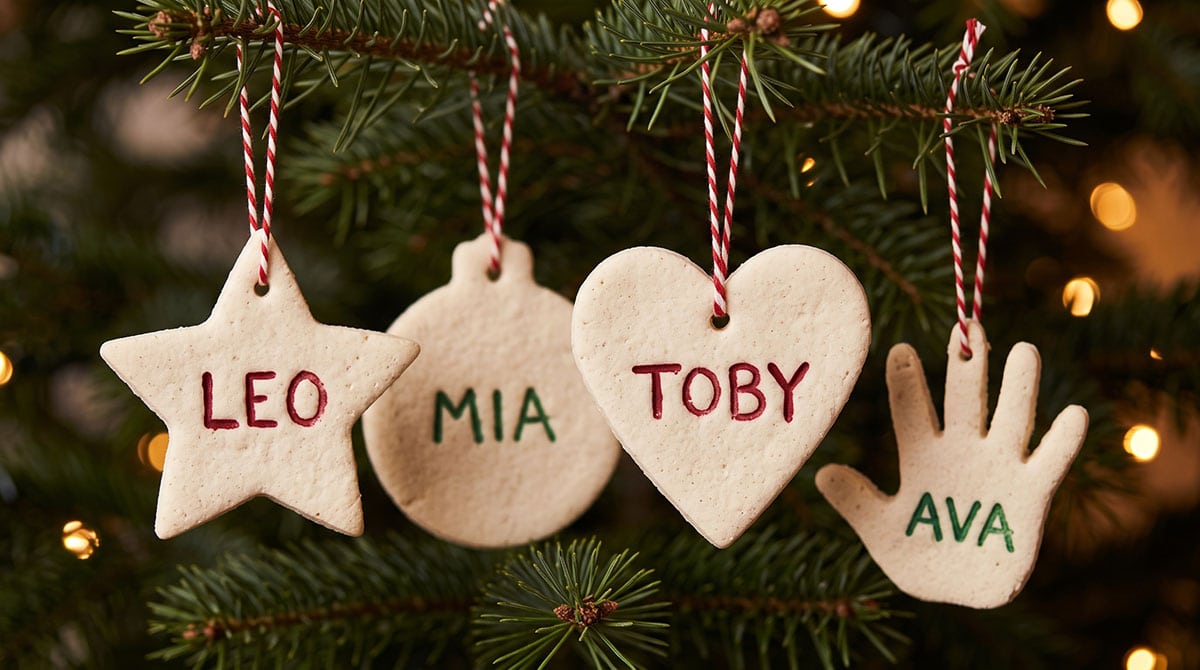
The free A.I. Santa activity pack has printable crafts, more ornament shapes, puzzles and coloring pages you can print again and again.
Get the Free Activity PackWhat is the checklist before I buy or let my child talk to one?
Quick Answer: Before buying an AI toy, look up the company, check what the toy can do, the parental controls, how it listens, any subscription, and the privacy policy. Before a child talks to a Santa app, ask whether it is pre-recorded or live and read the line on recordings. Nothing on this list guarantees safety.
This is built from published guidance. PIRG notes that "even if a toy passes the below tests with flying colors, it doesn't necessarily mean the toy is harmless."
Before buying an AI toy (PIRG, Common Sense Media)
- Look up the company and the product's news record, including government actions and privacy complaints.
- Check whether the company says which chatbot it uses and what it blocks. PIRG found none of the makers it tested "as transparent as we think they should be."
- Find out what the toy can do: microphone, camera, face or voice recognition, location sharing.
- Check the parental controls: transcripts, topic limits, time limits, alerts, a remote off switch. Common Sense Media notes they "are not entirely reliable."
- Learn how it listens: push-to-talk, a wake word, or always on. PIRG calls push-to-talk the safest of the three.
- Check for a subscription and what it unlocks, since some toys put parental controls behind a paid tier.
- Read the privacy policy for what is collected (voice prints and face scans especially), who it is shared with, how long it is kept and whether you can delete it.
- Ask whether the company will still exist next year. PIRG cites an $800 companion robot whose maker shut down.
- Weigh the age advice: Common Sense Media says no AI toys for ages 5 and under.
Before a child talks to a Santa app
- Ask whether it is pre-recorded or a live AI conversation. The name does not say.
- Find the privacy policy and read the line on recordings: how many days they are kept, and whether they are used to train AI.
- Check the app's privacy label and permissions (camera, microphone, photos), and remember the label is the developer's own declaration.
- Look for a parent lock, a parent review of paused chats and a daily time limit, and check for a free tier or subscription.
- Be in the room. One security vendor advises telling a child that a kind, lovable character does not mean they should share information with an app.
- Know that the names, wishes and interests a parent enters are stored in some products' accounts.
Talking with your child
- Ask what they use it for and whether it ever said anything creepy or false, calmly and with curiosity.
- Say plainly that a chatbot "can't think or feel," and that a toy that says "I love you" is a program, as the AAP's parent site puts it.
- Watch for warning signs, such as choosing the AI over people.

How do I explain a talking Santa without spoiling Santa?
Quick Answer: Say what the app is without taking Santa away. Three framings fit what pediatric guidance says about chatbots: it is a computer program that plays Santa; it guesses what Santa might say; and it is not a person and cannot have feelings. These are my suggestions. No study I read tests them, and I do not claim they protect belief in Santa.
A parent in r/Parenting asked, "Is it really so different if that Santa is now AI?" (post dated 2024-12-08 by page context). That is the worry the framings have to meet. The same post says the AI Santa chat felt convincing and the child's excitement did not fade. A commenter in that thread, seen only as a search-result snippet, says treating AI characters like real people is not good for kids. Parents feel both ways.
Spoiling Santa does not need an app. In several parents' accounts in the New York Post (2025-11-20), a general search assistant told children that Santa is not real, and one parent called it a "betrayal" (New York Post).
I wrote a second article that may help if you want something to read together: books about AI for kids. One of the six is A.I. Santa, a Christmas picture book I illustrated, and ReadnLearn earns from its sales, so weigh that. In its two-page conversation with Santa's helper Jingle, a child asks "Is A.I. a person?" and Jingle answers "No, A.I. is not a person and it cannot have feelings." You can see it on its book page. I do not claim a book changes how a child sees AI. I found no study that tests it. It is one read-together way in, among others.

In the book, Jingle puts it in four words: "A.I. is not magic."
Key Takeaways
- Child-advocacy and pediatric groups advise against AI toys for young children, or extreme caution. These are recommendations, and I found no rule specific to AI toys in force.
- Independent tests by PIRG, NBC News and Common Sense Media found inappropriate output from some AI toys. Results are specific to products and versions, and some makers have changed them.
- Retention terms differ widely, and they are self-reported. Check the policy, not the marketing, and date what you read.
- "AI Santa" can mean a pre-recorded call or a live AI conversation. Ask which.
- Young children more often credit machines with feelings. Research on chatbot toys with children aged 5 to 9 is thin.
- A checklist helps. It does not guarantee safety.
Frequently Asked Questions
Are AI toys safe?
It depends on the toy and the version. Independent testers found inappropriate output from some AI toys in 2025 and 2026, and some makers changed their products afterwards. The advocacy groups that advise parents say not to buy them for young children or to be extremely careful. A checklist can reduce the risk and cannot remove it.
Would you get your kid AI toys? (a question from Quora; the asker's role is unknown)
Common Sense Media advises no AI toys for children aged 5 and under, and extreme caution for ages 6 to 12. If a family decides to buy one for an older child, the advice in this article is to read the policy first, check the parental controls and be in the room. That is a summary of published guidance, not a tested method.
How concerned should parents be about privacy issues with AI toys? (Quora, asker's role unknown)
Concerned enough to read the policy. Retention terms run from "not stored" to 90 days to indefinitely, and almost none of it has been tested independently. Two data exposures have been reported: Bondu (confirmed by the company) and Miko (alleged by two senators, denied by Miko).
Should we completely avoid AI toys or tools for children under five? (Quora, asker's role unknown)
Common Sense Media advises no AI toys for ages 5 and under. Young children are also more likely to believe a talking machine has feelings. Most of that evidence is about robots and voice assistants, so treat it as a reason for caution, not a proven harm.
Is there a service out there that does this? (a parent in r/daddit, 2023-12-07, asking about a video call with Santa)
Yes, and many are pre-recorded, not live. Video Call Santa and Speak to Santa both say their calls are not live. Others use live AI conversation. Ask which kind before you hand over a child's details.
Is an AI Santa call or video the same as a call with the real Santa?
An AI Santa call or video is either a pre-recorded simulation or a live AI conversation. Neither is a real person, and the better apps say which they are. A plain way to put it to a child is that it is a computer program that plays Santa.
Where to start
If you read one thing before Christmas, read the privacy policy of whatever your child will talk to, and date it, because it can change. For something to read together, there is my list of books about AI for kids, and the for-parents page has more ideas for things to do at home. If you try the checklist and something surprises you, I would like to hear it.